

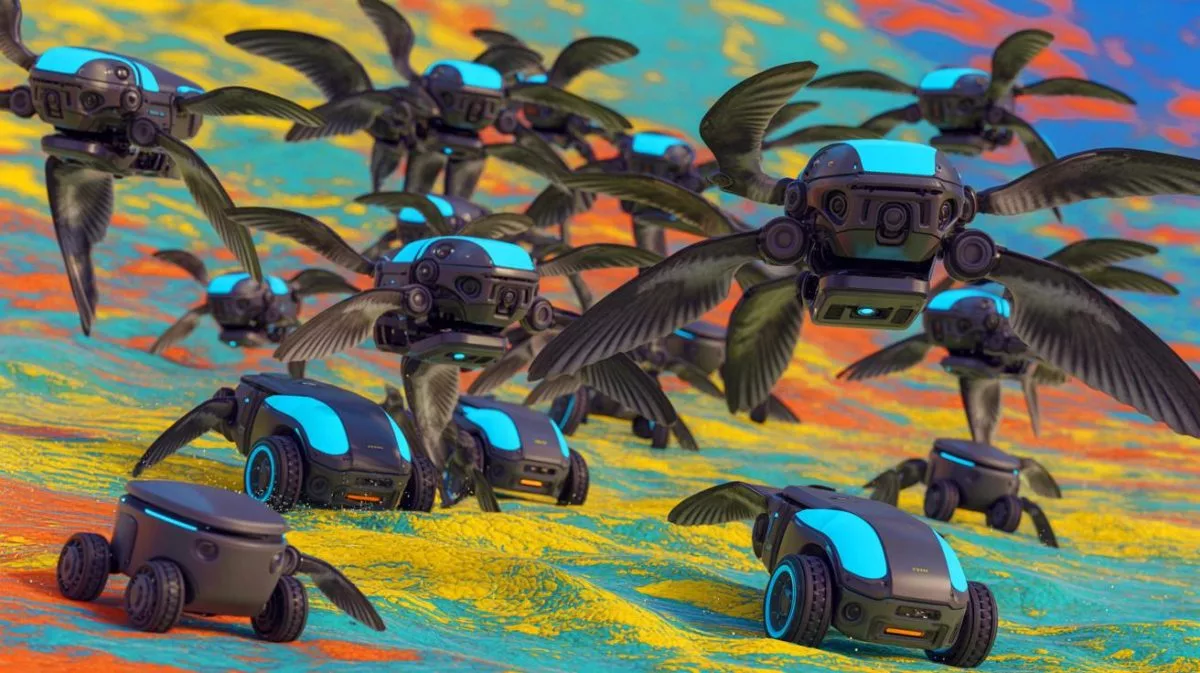
Researchers have developed a novel framework that enables robot swarms to replicate the elegant, decentralized motions seen in nature—flocks of birds, schools of fish, and swarms of bees. Called curvity, the new concept helps robots coordinate without a central controller, leading to more fluid, adaptive collective behavior.
What Is Curvity?
- Curvity is a geometric-oriented property assigned to each individual robot in a swarm. It’s like being given a “curvature charge” (positive or negative) that influences how a robot reacts to forces from its surroundings and from its neighbors.
- Robots with positive curvity tend to curve in one way, while those with negative curvity curve in an opposite sense. By mixing robots with different curvity values, entire swarms can be induced to cluster, flow together, or form dynamic flocks—hallmarks of natural collective behavior.
Main Insights & How They Did It
- The researchers created simple design rules based on geometry and motion. These rules are inspired by natural computation, similar to how electric charges (positive/negative) influence interactions in particles.
- Experiments showed that even when considering just two robots, the curvity values determine whether they attract or repel each other; this scales up to thousands of robots, where large-scale patterns emerge.
- Importantly, curvity can be embedded in the physical design of robots (their shape, structure) instead of being controlled only by software. That means some behavior is “built in” mechanically, simplifying control.
Why It Matters
- Decentralized Control: One big hurdle for swarm robotics has been making swarms that do complex tasks without a single leader. Curvity helps sidestep that by letting behavior emerge from how individuals interact, rather than via centralized commands.
- Scalability: Since the basic rules are simple and intrinsic, the framework can work whether there are dozens, hundreds, or thousands of robots. That’s vital for real-world applications.
- Versatility: Possible uses are wide ranging—search-and-rescue in disaster zones, wildfire monitoring, environmental sensing, and even medical uses like swarms of microscopic robots delivering drugs inside the body.
Challenges & Future Directions
- Real-world deployment will require dealing with noise, environmental uncertainties, hardware limitations, and energy constraints.
- Ensuring safety and predictability in chaotic conditions is critical. Robot swarms working in wild settings (uneven terrain, wind, obstacles) will test how well curvity holds up.
- Fine-tuning the mix of curvity values, mechanical design, sensory feedback, and algorithmic control will be key to achieving desired behaviors under different conditions.
Conclusion
The introduction of curvity marks a big step forward in mimicking nature’s impressive swarm behaviors. By embedding a simple curvature parameter in each unit and letting interactions drive collective outcomes, robots are moving closer to behaving like birds in flight or fish in water—without needing a “boss” robot telling everyone what to do.
This framework could reshape how swarm robotics are designed and used in many fields. As researchers refine the ideas and test them outside labs, we may see robot swarms doing things we once thought only living creatures could.














Leave a Reply