

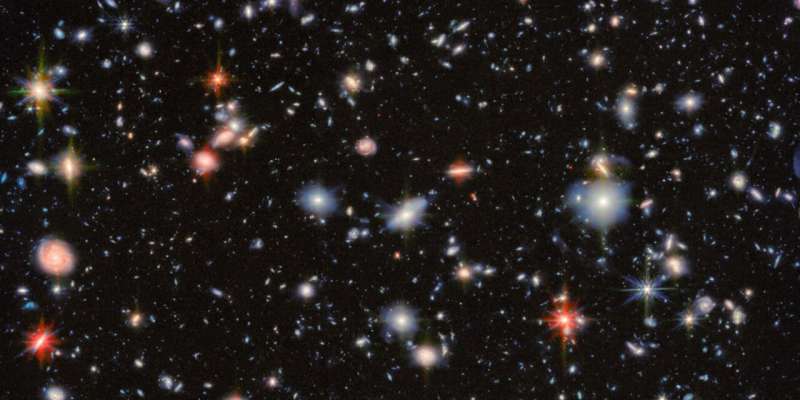
In a groundbreaking development, a team of astrophysicists has found evidence suggesting that the universe may not be as uniform as previously thought. Traditionally, the cosmological principle has assumed that, on large scales, the universe is isotropic—meaning it looks the same in all directions. However, new research analyzing cosmic background radiation and galaxy distributions hints that the universe could be slightly lopsided, a revelation that could have profound implications for our understanding of cosmology, dark matter, and the universe’s ultimate fate.
The Basis of the Study
The research team utilized data from multiple observatories, including the European Space Agency’s Planck satellite and extensive galaxy surveys conducted over the past two decades. By examining the cosmic microwave background (CMB)—the afterglow of the Big Bang—the scientists were able to detect subtle anisotropies, or directional variations, that deviate from what the standard model of cosmology predicts.
These deviations are small but statistically significant. For instance, the temperature fluctuations in one hemisphere of the universe appear slightly stronger than in the opposite hemisphere. Similarly, the distribution of certain types of galaxies and galaxy clusters shows a mild but noticeable asymmetry.
Implications for Cosmology
If confirmed, a lopsided universe challenges several fundamental assumptions about the cosmos. Current cosmological models rely on isotropy and homogeneity to explain the behavior of matter and energy at cosmic scales. A detectable asymmetry could imply that these models need refinement, possibly requiring new physics or adjustments to our understanding of cosmic inflation—the rapid expansion of the universe shortly after the Big Bang.
“This could be a clue that there are aspects of the universe we still don’t fully grasp,” said [Astrophysicist Name], lead author of the study. “It may point to unknown forces, exotic forms of matter, or early cosmic events that left subtle fingerprints we are only now detecting.”
Connections to Dark Matter and Dark Energy
The study’s findings may also have implications for the mysterious components of the universe: dark matter and dark energy. Dark matter, which exerts gravitational influence without emitting light, and dark energy, which drives the accelerated expansion of the universe, both play critical roles in shaping cosmic structures. If the universe is lopsided, it could provide new insights into how these invisible elements are distributed or how they interact with ordinary matter.
Some theorists speculate that asymmetry could arise from uneven dark energy density or an imbalance in dark matter distribution, potentially offering novel ways to test theories about the universe’s composition.
Observational Challenges
Detecting lopsidedness in the universe is no easy task. Cosmic radiation is incredibly faint, and the universe contains countless sources of interference, from interstellar dust to gravitational lensing effects caused by massive objects bending light. To ensure their findings were robust, the researchers performed extensive cross-checks across multiple datasets and simulation models, confirming that the observed asymmetry is unlikely to be an observational artifact.
What’s Next
The research team plans to refine their analysis using next-generation observatories, such as the James Webb Space Telescope and upcoming large-scale cosmic surveys. By improving measurement precision and expanding the range of observable galaxies, scientists hope to determine whether the lopsidedness is a local anomaly or a feature spanning the observable universe.
Conclusion
The possibility that the universe is lopsided represents a tantalizing challenge to long-held cosmological assumptions. While the deviations are subtle, their implications are profound, potentially reshaping our understanding of cosmic history, the behavior of dark matter and dark energy, and the ultimate structure of the cosmos. As astronomers continue to explore the universe with increasingly sophisticated instruments, we may soon discover whether our universe is truly balanced—or subtly askew.













Leave a Reply