

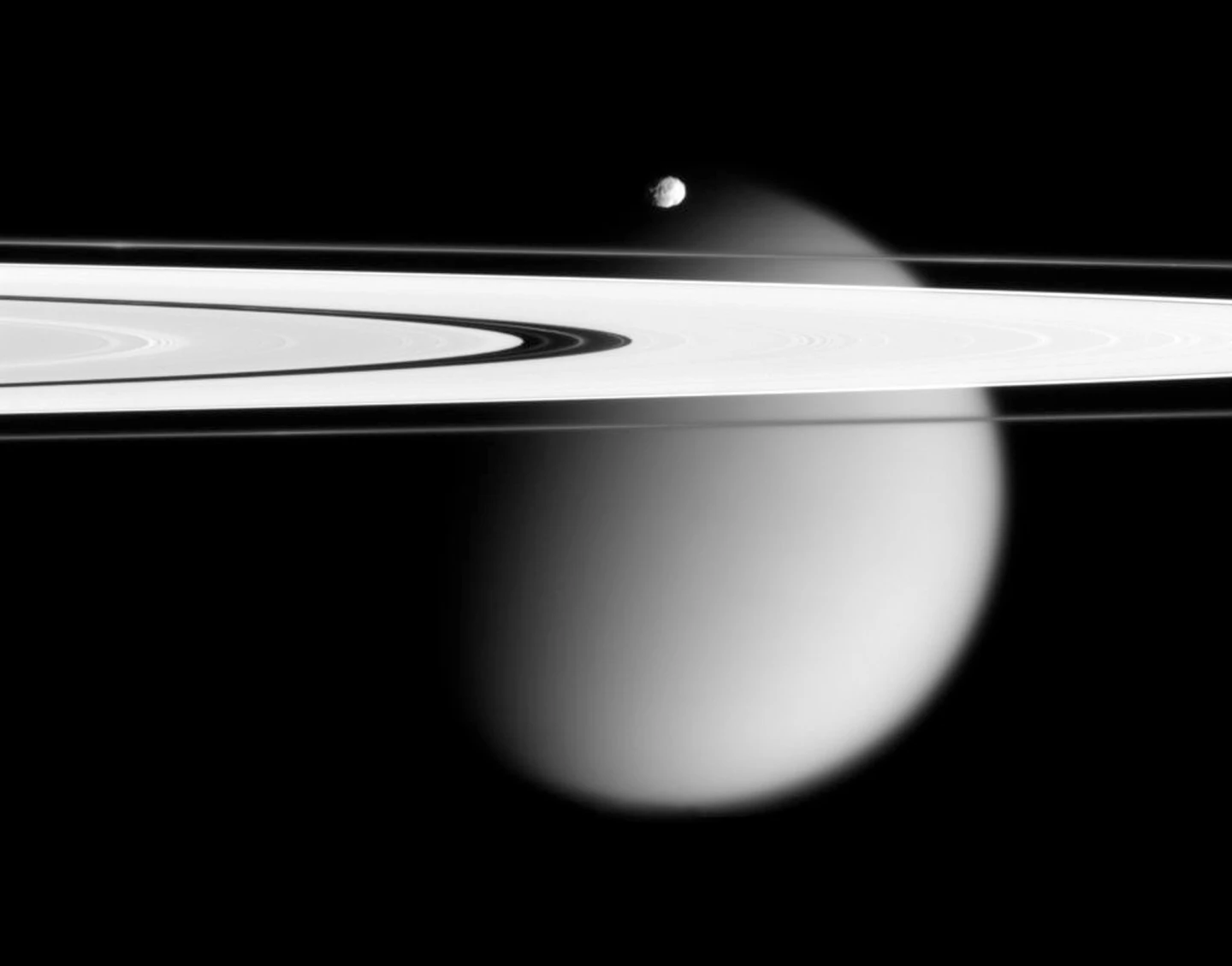
A recent study has cast doubt on a long-standing theory that Saturn’s largest moon, Titan, harbors a subsurface ocean. For decades, scientists have speculated that liquid water exists beneath Titan’s icy crust, potentially creating conditions favorable for complex chemistry or even life. The latest research, however, suggests that Titan’s interior may be far drier than previously thought.
Rethinking Titan’s Interior
Titan has fascinated scientists due to its thick nitrogen-rich atmosphere, hydrocarbon lakes, and weather systems reminiscent of Earth. Observations from the Cassini mission and Earth-based telescopes fueled the hypothesis that beneath its icy surface lies a liquid water ocean, insulated by layers of ice and ammonia.
The new study, based on refined gravitational models and thermal data, indicates that the moon’s crust and mantle are more rigid than expected. Researchers argue that these measurements are inconsistent with a global subsurface ocean, suggesting that Titan’s interior may instead consist of solid ice and rock.
Implications for Astrobiology
The possibility of a buried ocean had positioned Titan as a prime candidate in the search for extraterrestrial life. While the moon’s surface already hosts complex organic chemistry, the absence of a subsurface ocean reduces the likelihood of environments capable of sustaining life as we know it.
Dr. Elena Varga, lead author of the study, notes, “Titan remains a unique world with fascinating chemistry, but our findings suggest we may need to temper expectations about its habitability beneath the ice.”
A Revised Understanding of Titan’s Geology
The study also reshapes theories about Titan’s geological activity. Previously, models suggested that tidal forces from Saturn could generate enough heat to maintain a liquid ocean. The new data imply that Titan’s interior may be more thermally stable, potentially limiting geological resurfacing and cryovolcanic activity.
However, researchers caution that localized pockets of liquid water cannot be entirely ruled out. Even without a global ocean, small subsurface reservoirs could still exist and contribute to Titan’s dynamic surface features.
Looking Ahead: Future Exploration
NASA’s Dragonfly mission, set to launch later this decade, may provide additional insights into Titan’s structure and chemistry. By analyzing surface composition, wind patterns, and seismic activity, Dragonfly could help confirm or challenge the new model of a dry interior.
Even if Titan lacks a subsurface ocean, its complex atmosphere, methane lakes, and organic chemistry ensure that it remains one of the most compelling worlds in the Solar System for ongoing exploration.













Leave a Reply