

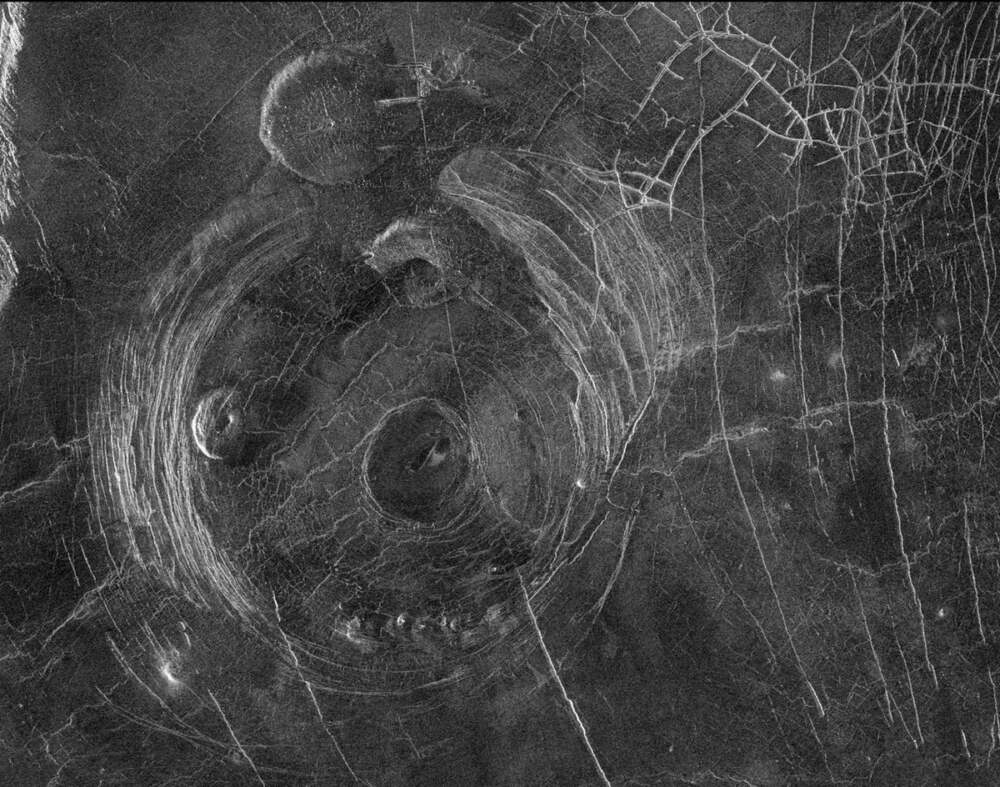
A recent scientific study has shed light on the long-standing mystery of Venus’s crown-shaped surface features known as coronae. These geological formations, which only appear on Venus to this degree, have puzzled scientists for decades. The new work suggests that a hidden barrier deep inside Venus’s mantle influences how heat and magma move, shaping these unique features.
What Are Coronae?
Coronae on Venus are circular or oval surface structures that can vary widely in size. Some appear as raised rings or ridges, others as sets of terraces or shallow basins. Scientists have catalogued hundreds of them across the planet’s globe, from small features a few tens of miles across to enormous crown-like rises hundreds of miles wide.
Unlike Earth, Venus lacks moving tectonic plates; its outer shell (lithosphere) behaves more like a single rigid layer, which makes these coronae especially intriguing as clues to Venus’s internal heat and geological activity.
The “Glass-Ceiling” Model: What’s New
The recent study, led by researchers at the Scripps Institution of Oceanography, proposes that a transition zone in Venus’s mantle acts like a ceiling that blocks many rising hot plumes deep below. Key points of the model:
- At depths of roughly 370–600 miles beneath Venus’s surface, there is a zone where rock changes its crystal structure due to high pressure and temperature. This causes a phase transition layer that resists direct upwelling of hot material.
- Only the most powerful plumes (columns of hotter, buoyant material rising from deeper in the mantle) have enough energy to breach this barrier. When they make it all the way to the surface, they form the largest coronae or uplifted swells.
- More commonly, smaller plumes get stalled beneath this ceiling. These accumulate and spread sideways, creating thermal instabilities below the barrier. From these, secondary upwellings emerge closer to the surface and form smaller coronae. These features are more numerous and widespread.
- Also, there are colder “drips”—dense material that begins to sink from the surface or outer mantle, helping to push up underlying hot material in what one might imagine as a kind of feedback loop of rising and sinking material.
Why This Helps Solve a Big Puzzle
This model helps explain several previously puzzling observations:
- Variety in sizes: Because some plumes break through and others do not, coronae on Venus come in many different sizes, shapes, and prominence of elevation.
- Distribution: Coronae appear across regions with different geological histories, but always in association with signs of past mantle activity. The glass-ceiling barrier helps explain why many coronae are not associated with massive hotspots but more subtle thermal patterns.
- Heat management: Without plate tectonics, Venus must lose internal heat by other mechanisms. The model gives a plausible way for Venus’s interior to process and release heat through “leaky” behavior: both major upwelling and many smaller, secondary ones.
Open Questions & What Comes Next
While the glass-ceiling model is a strong candidate, scientists note that more work remains:
- The exact composition of Venus’s mantle is not known. Differences in rock type, presence of volatile materials (e.g. water, sulfur), and temperature can affect how strong the barrier is, how deep it lies, and how well plumes can penetrate it.
- The model so far is based largely on computational simulations. More detailed three-dimensional models, incorporating melting, various mantle chemistries, and realistic variation in temperature and pressure, are needed to test it more thoroughly.
- Upcoming missions to Venus—especially those that will gather higher resolution gravity, radar, and topographic data—are expected to help confirm or refine where this barrier is, how thick it is, and how coronae have evolved over Venus’s history.
What It Tells Us About Venus (and Earth)
- Venus, often called Earth’s “twin” for its similar size and composition, clearly followed a very different path. While Earth developed active plate tectonics, Venus appears to have been held back (or shaped differently) by this internal barrier and by heat-transfer processes beneath its surface.
- Understanding these coronae helps scientists figure out why Venus became so inhospitable, with runaway greenhouse conditions, thick toxic atmosphere, and surface temperatures and pressures that are extreme—despite starting off with materials and energy somewhat similar to Earth’s.
- The insights gained could also help in the study of rocky planets outside our solar system: how interiors evolve, how surface geology expresses internal structure, and what conditions might lead to more Earth-like behavior versus a more static or “stagnant lid” world like Venus.
Bottom Line
The crown-like coronae of Venus, long a geological puzzle, may finally have an explanation rooted in the planet’s deep interior. A hidden barrier in the mantle—this “glass ceiling”—could control which thermal upwellings reach the surface, shaping everything from massive volcanic rises to smaller coronae. If verified by upcoming missions and improved models, this idea could reshape how we understand Venus, its history, and the dynamics of planetary interiors across the universe.














Leave a Reply