

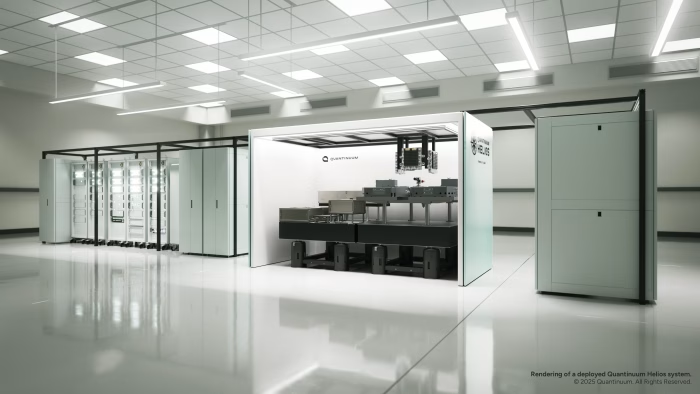
In a major milestone for the tech industry, Quantinuum has unveiled its latest quantum computer, “Helios,” signaling a significant step toward practical, large-scale quantum computing. The machine represents one of the most advanced quantum systems to date, blending cutting-edge hardware with sophisticated error-correction capabilities.
Helios is equipped with 98 physical qubits and 48 logical qubits that are fully error-corrected, allowing it to perform computations far more reliably than previous quantum machines. Logical qubits, which are made from groups of physical qubits, are essential for practical quantum computation because they correct errors that naturally occur in quantum systems.
This breakthrough opens the door for enterprises to explore complex quantum algorithms for applications in finance, materials science, pharmaceuticals, and cybersecurity. Notably, major companies such as JPMorgan Chase have already begun testing algorithms on the new system, exploring quantum approaches to portfolio optimization, risk modeling, and secure data encryption.
Dr. Elena Moreno, chief scientist at Quantinuum, described Helios as “a transformative platform that bridges the gap between experimental quantum devices and real-world applications.” She emphasized that the system’s error-corrected qubits provide a stable foundation for running complex calculations that were previously impossible on traditional quantum computers.
The launch of Helios highlights the rapid progress in the quantum computing sector. Just a few years ago, error-corrected logical qubits were largely theoretical. Now, they are being integrated into commercial systems, promising faster breakthroughs and more efficient problem-solving capabilities across multiple industries.
Experts say that while the technology is still in its early stages, machines like Helios mark the beginning of a new era in computing. With more companies investing in quantum research and development, the next decade could see these machines tackling problems that are currently beyond the reach of classical supercomputers.














Leave a Reply