

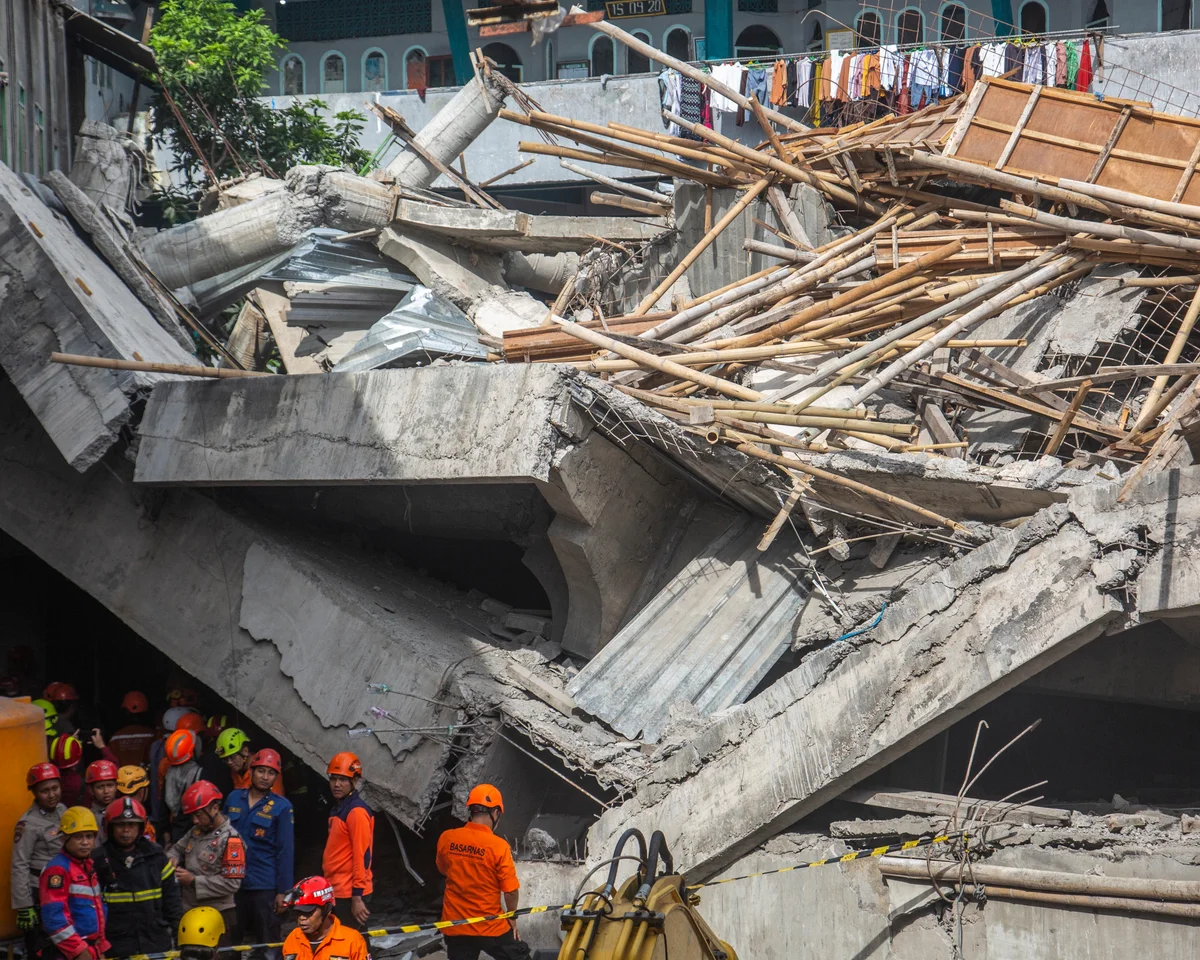
Sidoarjo, East Java — A tragic disaster has shaken the province of East Java, Indonesia, where a multi-story building of an Islamic boarding school collapsed during late afternoon prayers, leaving dozens dead, scores injured, and many still unaccounted for. The collapse has triggered a massive rescue operation fraught with danger, as authorities warn that time is running short for survivors trapped under debris.
Collapse During Prayers and Unauthorized Construction
The disaster took place on a Monday afternoon inside Al Khoziny Islamic Boarding School in Sidoarjo, an area situated on Java’s eastern side. Students were performing midday prayers in a prayer hall on the lower floors of the building when the structure gave way. At the time, upper levels were undergoing expansion work.
Local authorities say that two additional floors had been under construction—without proper permits in many accounts—on top of an older structure originally built for fewer levels. The building’s foundation reportedly lacked the capacity to support the extra load. The collapse unleashed enormous slabs of concrete and steel onto the praying students below.
Casualties, Missing, and Rescue Figures
By the latest tally:
- Confirmed dead: At least three individuals
- Missing / unaccounted for: Around 91 people, mostly teenage boys
- Injured: Over 100, many with critical injuries
- Rescued alive so far: Several, including a boy pulled from the rubble; details of their condition are not fully released
Some survivors were able to escape because they were praying in separate areas; female students, for example, were reportedly in a different wing and many avoided harm. But the majority underneath the collapsed section remain trapped.
Search and Rescue: A Delicate, Dangerous Operation
Rescuers—composed of national and local disaster agencies, military, police, volunteers, and medical teams—are working around the clock to reach those buried beneath the wreckage. Their progress, however, is slowed by multiple challenges:
- Structural instability: The debris is precarious, and nearly all of the collapsed structure is unstable. Rescuers have been reluctant to use heavy machinery out of fear of triggering further collapse and harming those still alive underneath.
- Compacted debris: Officials say that aftershocks or tremors may have compressed the debris further, narrowing voids and making passage more difficult. In some instances, a space that was once 50 centimeters (about 20 inches) tall reportedly narrowed to just 10 centimeters (4 inches) deep, significantly complicating access.
- Limited access holes: Search crews are carefully creating small “tunnel-style” passages, relying on hand tools, sensors, thermal cameras, and acoustic equipment to detect survivors.
- Provision of life support: Rescuers are sending oxygen, water, and small packages of food through narrow gaps to people they believe are still alive beneath the rubble.
- Detection of signs of life: In multiple spots, cameras and sensors have recorded movement, flickers, or faint signs of breathing, helping rescuers narrow search zones to target victims’ likely locations.
Despite the dangers, the rescue effort continues at a frantic pace, with officials citing the “golden hours” after collapse as the most critical window for saving lives. Every minute counts.
Root Causes & Oversight Failures
While the immediate focus is rescue, questions are already being raised about what led to this catastrophe. Early indications point to:
- Overloading / foundation failure: The original foundations were likely not designed to support the added weight of two new floors. When full concrete slabs for additional levels were poured, the structure could not bear the load.
- Lax regulation / unauthorized expansion: Reports suggest that the building expansion lacked proper oversight and permits. Such additions may have proceeded without proper structural audits or reinforcement.
- Building safety enforcement: Critics point out that in many parts of Indonesia, construction rules—especially for religious or private institutions—are unevenly enforced. Safety inspections, structural assessments, and compliance with engineering standards are often weak or inadequately monitored.
- Maintenance and aging structure: The original portions of the building may have aged or degraded, making them less resilient to new stress. When combined with new construction, the entire load system may have failed.
In the aftermath, investigators have already begun probing construction records, permit filings, and engineering approvals to determine responsibility and whether negligence or illegal activity played a role.
Human Drama & Heartbreak
Amid the rubble and sirens, there is profound human sorrow. Relatives and parents have gathered at the site and hospital wards, praying, weeping, and searching whiteboards listing known survivors and missing names. Some parents have shouted the names of their children into the wreckage, desperate for response. Others wait in hospital corridors for fragments of news.
One uncle, clutching tearfully to a photograph of his nephew, expressed hope that a faint cry or movement would lead to salvation. The emotional toll is vast—grief, fear, uncertainty—all mingling in a community devastated by sudden loss.
Government Response & Support Measures
The provincial government has declared a disaster emergency in the affected areas. Command centers have been established at the collapse site and in nearby hospitals to coordinate rescue, medical care, and family support. Relief supplies—blankets, medical kits, water, food—are being mobilized.
Indonesia’s president and senior officials have offered condolences and pledged full government backing for rescue, recovery, and eventual rebuilding. Committees are being formed to oversee investigations, structural audits, and accountability for any wrongdoing.
Lessons, Reforms & Policy Implications
This catastrophe highlights broader concerns going beyond one school:
- Stronger building codes and enforcement: Institutions of all kinds, especially schools, must adhere to rigorous safety standards—especially when expansion is involved.
- Mandatory structural assessments for renovations: Before any building is expanded vertically, certified engineering reviews should be mandatory, and approval withheld if structural risk is found.
- Transparency in permits and inspections: Local authorities must tighten oversight, ensuring no expansions occur without permit checks and structural safety verification.
- Disaster readiness and rapid response capacity: Indonesia, a nation prone to earthquakes and heavy rainfall, needs stronger rescue infrastructure, rapid deployment teams, and tools for complex extrication in urban rubble.
- Public awareness and accountability: Communities should be empowered to demand safe construction practices and raise alerts if unsafe works are underway.
The Road Ahead
The hours and days following this school collapse are critical—not only for rescue outcomes but for shaping how Indonesia responds to structural safety nationwide. The missing may yet be found alive, or the death toll may rise further. Families will demand answers, and pressure will mount on authorities to prevent future tragedies.
For now, the rescue teams continue, digging cautiously through broken concrete, threading life-saving supplies into hidden crevices, listening for faint signs of consciousness. Hope persists, even amid devastation—and a nation watches as every movable slab, every beam, might hold the fate of a child still waiting to be found.














Leave a Reply