

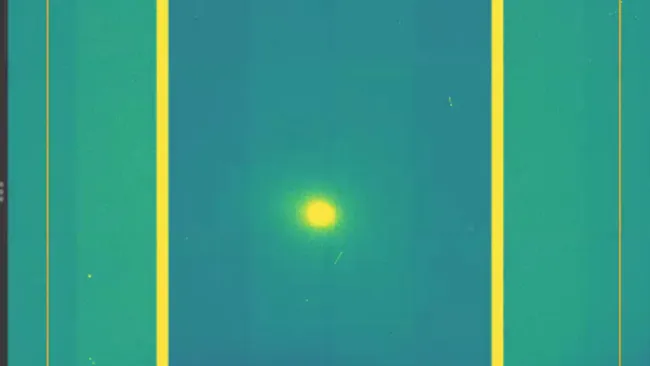
Astronomy enthusiasts recently witnessed a rare celestial event as scientists tracked interstellar comet 3I/ATLAS as it departed the solar system—live. Observers described the experience as “prime-time science,” highlighting the excitement of seeing cosmic phenomena unfold in real time.
3I/ATLAS, first detected in 2020, is only the third confirmed interstellar object to pass through our solar system, following ‘Oumuamua in 2017 and 2I/Borisov in 2019. Unlike typical comets that orbit the Sun in predictable elliptical paths, interstellar objects originate from beyond our solar system, traveling at high speeds and offering a unique glimpse into the conditions of distant star systems.
Using a network of ground-based telescopes and space observatories, scientists tracked the comet’s trajectory as it moved past Neptune and headed into interstellar space. The real-time observations allowed astronomers to monitor changes in the comet’s coma and tail, providing valuable data on its composition and interaction with solar radiation.
“This is some prime-time science,” said Dr. Laura Chen, an astrophysicist involved in the tracking efforts. “To observe an object from another star system moving through our neighborhood is extraordinary. Real-time data lets us study its properties in ways we could only dream of before.”
3I/ATLAS has a highly elongated trajectory, traveling at speeds exceeding 100,000 miles per hour, making it impossible for the Sun’s gravity to capture it. Its brief visit provided a fleeting but valuable opportunity for astronomers to study materials from outside our solar system, potentially revealing insights about planetary formation in other star systems.
Amateur astronomers and space enthusiasts also joined the excitement, using online feeds to follow the comet’s movement. Social media buzzed with snapshots, visualizations, and commentary, reflecting the rare intersection of professional science and public engagement.
As 3I/ATLAS exits the solar system, astronomers will continue to analyze the data collected, searching for clues about its origin and composition. Each interstellar visitor adds a piece to the puzzle of our cosmic neighborhood, offering humanity a chance to study distant worlds without leaving Earth.
The live tracking of 3I/ATLAS marks a milestone in observational astronomy, demonstrating how rapidly advancing technology allows scientists—and the public—to witness the dynamic universe as it happens.









Leave a Reply