

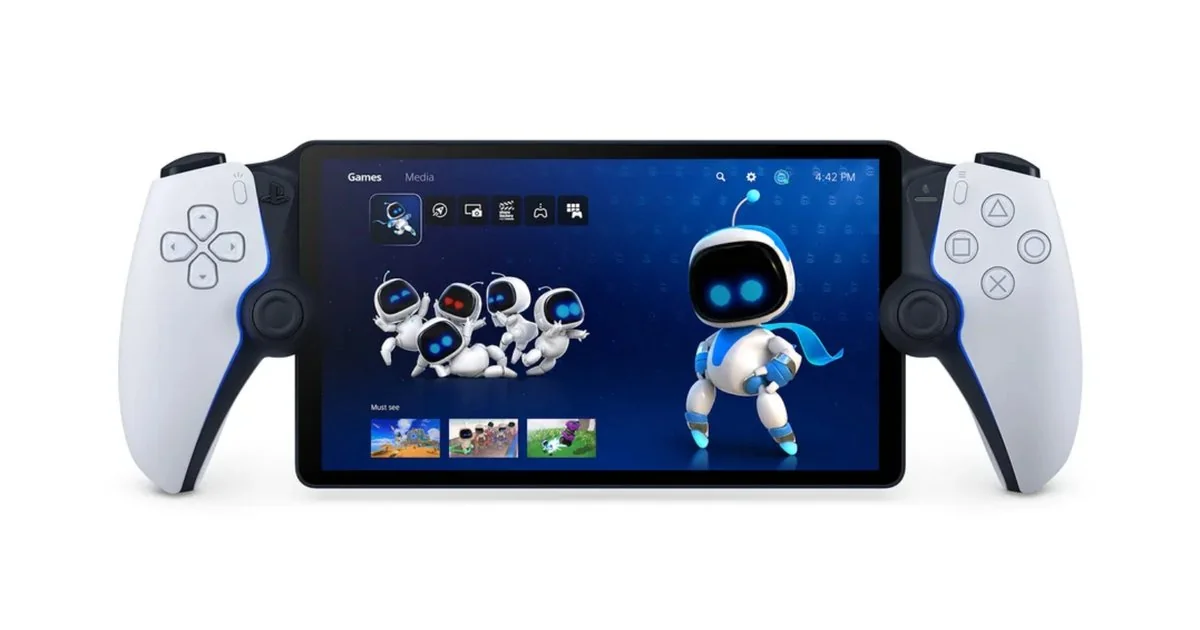
Sony has unveiled a landmark update for the PlayStation Portal, transforming the handheld device from a simple Remote Play accessory into a full-fledged cloud gaming platform. For the first time, gamers can stream PlayStation 5 titles directly from the cloud — without owning or connecting to a PS5 console. The rollout represents one of Sony’s most significant steps yet toward a cloud-first gaming future.
The Next Phase of PlayStation’s Streaming Vision
Since its debut, the PlayStation Portal has been limited to local streaming via Wi-Fi, meaning players needed a PS5 console at home to mirror their games. That restriction made the device useful but somewhat niche. With this update, Sony is tearing down that limitation by enabling full cloud streaming for PlayStation Plus Premium members.
Through this service, users can access a wide range of PS5 titles hosted on Sony’s cloud servers. The company confirmed that more than 2,000 games will be playable at launch, including blockbuster exclusives and fan-favorite third-party titles. This development effectively redefines the Portal’s purpose — from a companion device to a self-contained streaming console.
How the Cloud Gaming Upgrade Works
Starting this month, PlayStation Plus Premium subscribers can stream titles from the PlayStation Plus Game Catalog and the Classics Catalog directly on the Portal. Games like God of War Ragnarök, Cyberpunk 2077, The Last of Us Part II Remastered, Spider-Man 2, and Hogwarts Legacy are among the highlights.
The update introduces a streamlined interface featuring three main sections:
- Remote Play – for traditional console-to-device streaming.
- Cloud Streaming – to access the PS5 library without a console.
- Search and Discover – enabling users to browse new releases and trending games easily.
Additionally, Sony has rolled out new system enhancements:
- Improved 3D audio for immersive sound.
- Upgraded multiplayer connectivity for smoother online play.
- Enhanced battery optimization for extended sessions.
- A parental lock and passcode feature for account security.
A Broader Strategic Shift for Sony
This update signals Sony’s growing commitment to cloud gaming, an area that continues to evolve as internet infrastructure improves globally. Competitors like Microsoft and Nvidia have already established strong presences with Xbox Cloud Gaming and GeForce Now. Sony’s move ensures that PlayStation remains relevant in an industry slowly shifting toward device-agnostic gaming.
By decoupling the Portal from the PS5, Sony is experimenting with a hybrid model that leverages its console ecosystem while investing in future technologies. Analysts view this as part of Sony’s long-term strategy to create an interconnected network of devices — from consoles to handhelds to smart TVs — capable of streaming PlayStation content anywhere, anytime.
Challenges Ahead
Despite the excitement, the new feature won’t come without challenges.
Cloud gaming is still heavily dependent on internet speed and stability. Lag, resolution drops, and input delays remain common issues, especially in regions with inconsistent broadband quality.
Moreover, because the Portal does not process games locally, it still functions purely as a streaming interface. Players without strong Wi-Fi or a high-speed mobile connection may find the experience inconsistent.
There are also questions about pricing and accessibility. While the PS Plus Premium subscription includes the cloud service, not every user may be willing to pay the higher tier for the experience. Still, for many gamers who want console-quality titles on the go, the trade-off could be worthwhile.
The Future of PlayStation on the Go
Sony’s new update effectively redefines what portable gaming means for the company. Unlike Nintendo’s hybrid Switch or Valve’s PC-based Steam Deck, the PlayStation Portal now represents Sony’s vision of “stream-first handheld gaming.”
If executed successfully, this model could pave the way for a broader hardware lineup centered on cloud connectivity — possibly even future devices that run PlayStation games natively via streaming.
Developers and publishers may also benefit from this shift, as it could open new markets and reduce reliance on traditional console distribution.
Community and Industry Reaction
Early reactions from the gaming community have been largely positive. Fans have praised Sony for finally giving the Portal a meaningful upgrade that justifies its hardware. Tech critics have noted that this could “breathe new life” into a device that was initially seen as an expensive accessory with limited functionality.
However, skepticism remains over the long-term viability of streaming-only handhelds. Some players still prefer the tactile assurance of physical hardware, fearing cloud dependence could make gaming experiences feel less stable or personal.
Conclusion
The PlayStation Portal’s latest update is more than a software enhancement — it’s a statement of intent. By embracing cloud streaming, Sony is positioning itself for the next evolution of interactive entertainment. While challenges like latency and connectivity remain, the company’s move marks a defining moment for the PlayStation ecosystem.
In an industry where boundaries between consoles, PCs, and cloud services are rapidly blurring, the Portal’s transformation may be remembered as Sony’s first decisive step toward the post-console era.











Leave a Reply