

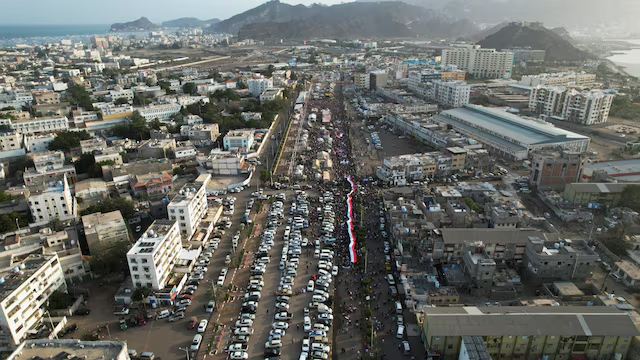
Southern Yemeni separatists have firmly dismissed a Saudi-led call to withdraw their forces from Yemen’s eastern provinces, deepening political and military tensions within the fractured country and complicating efforts to stabilize the region. The refusal underscores the growing rift between Saudi Arabia and its former allies in southern Yemen, even as Riyadh seeks to consolidate influence and reduce internal conflict.
Leaders of the Southern Transitional Council (STC), which advocates for the re-establishment of an independent South Yemen, said their forces would remain deployed in strategic eastern areas, arguing that their presence is essential for maintaining security. The group accused external actors of attempting to marginalize southern interests under the guise of de-escalation and warned that any forced withdrawal could create dangerous security vacuums.
Saudi Arabia has reportedly urged southern forces to pull back as part of broader efforts to streamline military authority under the internationally recognized Yemeni government. Riyadh has positioned itself as a mediator attempting to unify anti-Houthi factions, but the STC views the request as undermining its political legitimacy and military gains achieved over recent years.
The eastern provinces, including resource-rich and strategically located areas, have become a focal point of power struggles among Yemeni factions. While largely spared from frontline fighting with the Houthis, these regions are vital due to oil infrastructure, ports, and supply routes. Southern separatists argue that withdrawing now would expose the area to militant infiltration and criminal networks, threatening both local stability and regional security.
STC officials emphasized that their forces were deployed at the request of local authorities and tribal leaders, portraying themselves as protectors rather than occupiers. They also reiterated their long-standing demand for international recognition of southern self-rule, framing Saudi pressure as a setback to political dialogue rather than a step toward peace.
Analysts say the dispute reflects deeper contradictions within the Saudi-led coalition, which has struggled to balance competing allies since intervening in Yemen’s war. While Saudi Arabia backs the internationally recognized government, the United Arab Emirates has historically supported southern separatists, creating overlapping chains of command and conflicting agendas on the ground.
The standoff raises concerns about renewed infighting among anti-Houthi forces, a pattern that has previously weakened efforts to confront the rebel group controlling much of northern Yemen. Any escalation between Saudi-backed units and southern separatists could further fragment the country and prolong the humanitarian crisis, which remains one of the world’s worst.
Local residents in the east expressed mixed reactions. Some welcomed the continued presence of southern forces, crediting them with improved security, while others worried that political rivalries could eventually spill into violence. Community leaders called for dialogue to avoid turning eastern Yemen into another battleground.
As diplomatic initiatives attempt to revive a stalled peace process, the separatists’ rejection of Saudi demands highlights the complexity of Yemen’s conflict. With multiple power centers pursuing divergent visions for the country’s future, the path toward lasting stability remains uncertain, and alliances once considered solid continue to shift under the strain of prolonged war.








Leave a Reply