

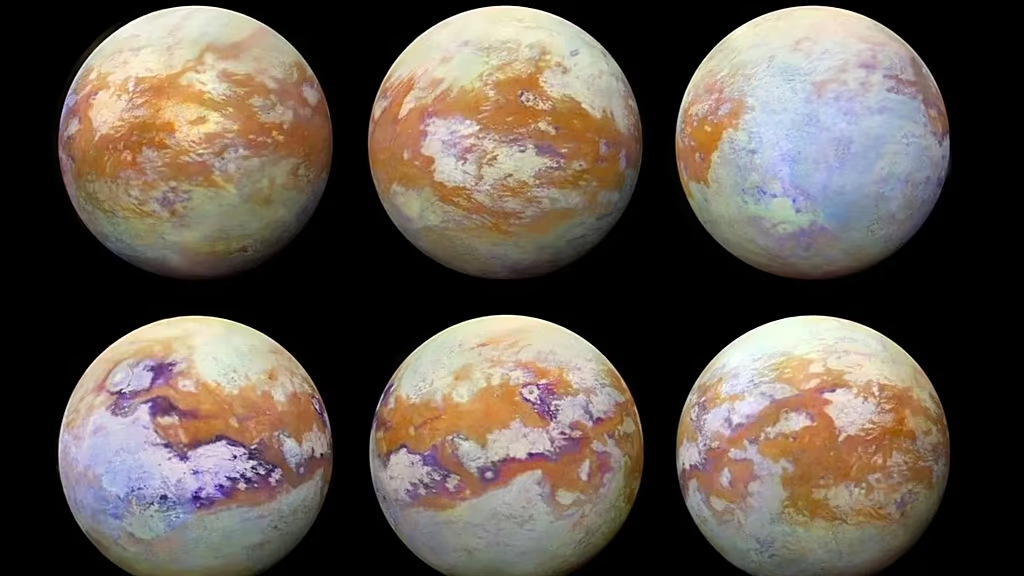
A groundbreaking study has revealed that Titan, Saturn’s largest moon, may contain slushy ice layers beneath its frozen crust, raising the possibility of habitable pockets where life could potentially exist. The findings provide new insights into the moon’s internal structure and its potential as a target for astrobiology.
Slushy Ice Beneath a Frozen Surface
Scientists used data from spacecraft observations and advanced computer models to probe Titan’s interior. The analysis indicates that Titan’s icy shell is not uniformly solid; instead, it contains regions where ice mixes with liquid water, forming a slushy, semi-fluid layer.
This slushy composition is believed to result from internal heating caused by tidal forces from Saturn and the moon’s own radioactive decay. These partially melted layers may allow movement of water and organic molecules, potentially supporting environments conducive to life.
Potential Habitable Zones
While Titan’s surface is extremely cold, averaging around -179°C (-290°F), the slushy ice layers beneath may create localized regions warm enough for microbial life. These pockets could harbor liquid water and dissolved organics, providing conditions similar to extremophile habitats on Earth.
Researchers emphasize that these zones are likely isolated and small, but their existence challenges previous assumptions that Titan’s icy shell is entirely inhospitable. The study suggests that life may be possible even in environments long considered too extreme.
Why Titan Matters for Astrobiology
Titan has been a focus of scientific interest due to its thick nitrogen-rich atmosphere, methane lakes, and complex organic chemistry. The discovery of slushy layers with potential habitable zones adds a new dimension, making Titan a prime candidate for future missions seeking signs of life.
Upcoming missions like NASA’s Dragonfly rotorcraft, slated to explore Titan in the late 2020s, may provide critical data to confirm these hypotheses. By analyzing surface and subsurface composition, Dragonfly could help scientists better understand Titan’s potential to support life.
Broader Implications for Icy Worlds
The findings also offer insights for other icy moons, such as Europa and Enceladus, where subsurface oceans and slushy layers may exist. Understanding Titan’s internal structure could help scientists identify common conditions that make moons in our solar system viable candidates for life.
While Titan’s frozen landscape appears forbidding, its hidden slushy layers could hold the keys to understanding how life might survive in extreme environments beyond Earth.













Leave a Reply