

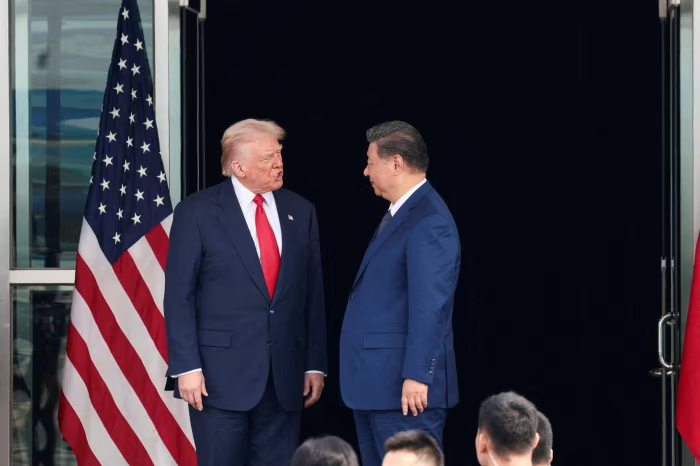
Former U.S. President Donald Trump’s latest national-security strategy marks a notable shift in tone toward China, softening language that previously framed Beijing as a primary strategic threat. The updated document, released by his advisory team, signals a recalibration of priorities as global tensions evolve and U.S. policymakers reassess long-term geopolitical risks.
In contrast to Trump’s earlier, more combative rhetoric, the new strategy emphasises “managed competition” with China rather than outright adversarial positioning. While it reaffirms concerns over technology theft, military expansion, and economic coercion, it avoids the sharper phrases that once defined the U.S.–China rivalry during Trump’s time in office.
Analysts suggest the shift may reflect changing international dynamics, including Washington’s focus on other global flashpoints and the recognition that cooperation with Beijing remains essential in issues like trade stability, supply chains, and nuclear nonproliferation. The strategy also highlights the need to strengthen regional partnerships in the Indo-Pacific, but frames these efforts as stabilising rather than confrontational.
Critics argue the softer language risks sending mixed signals at a time when China continues to modernise its military and assert its influence in the South China Sea. Supporters, however, say a more balanced approach could prevent unnecessary escalation and create space for pragmatic engagement between the world’s two largest economies.
The document also underscores domestic economic security, innovation investment, and military readiness as key pillars of U.S. global strength—signalling a belief that outcompeting China begins at home rather than solely through external pressure.
Although the strategy does not mark a full departure from Trump’s prior positions, it illustrates an attempt to reshape the narrative in an increasingly complex environment. As both nations navigate a mix of rivalry and interdependence, Washington’s recalibrated stance may set the tone for future diplomacy and global power dynamics.











Leave a Reply