

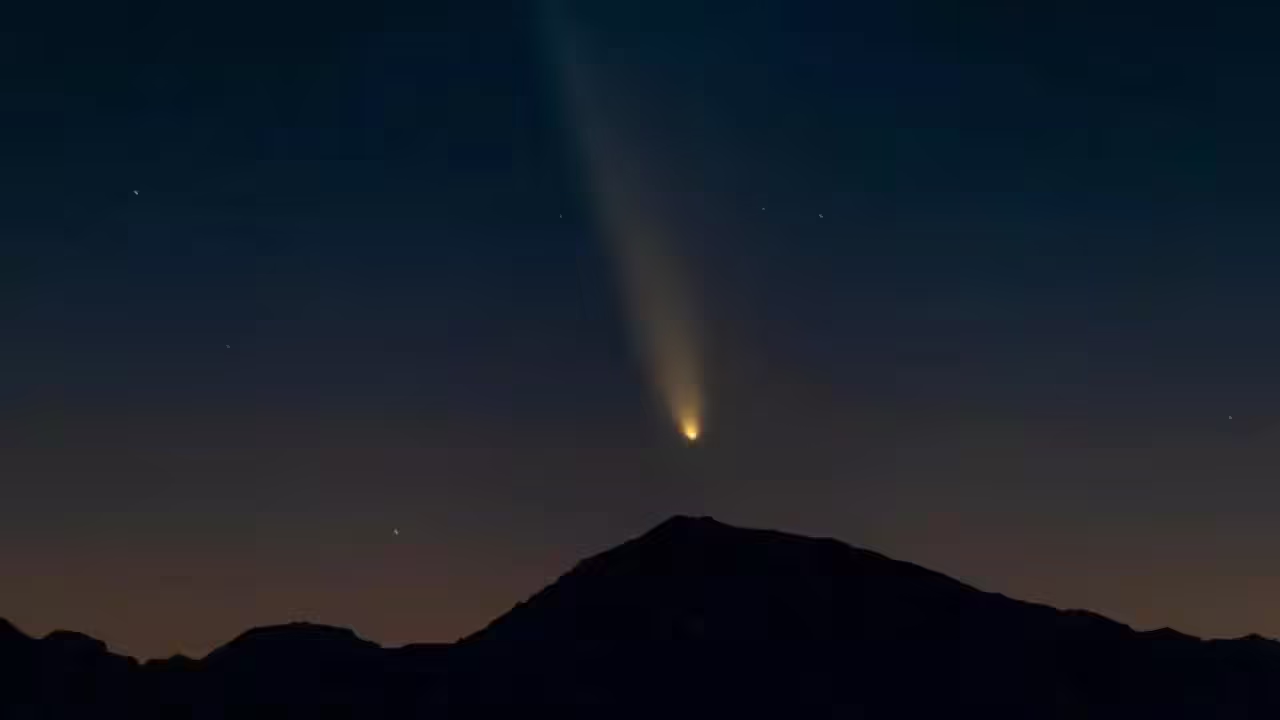
The cosmos is preparing to deliver a spectacular display this October, as two brilliant green comets—Comet Lemmon and Comet SWAN—grace the night skies simultaneously. This rare celestial event has astronomers and stargazers around the world eagerly preparing for what could be one of the most memorable skywatching experiences of the year.
Both comets, each new to the inner solar system, are expected to brighten considerably in the coming days, offering a once-in-a-generation view of twin glowing wanderers traversing the heavens. For those lucky enough to find clear, dark skies, these cosmic visitors could appear as luminous green orbs streaking against the backdrop of stars.
The Science Behind the Green Glow
The vibrant green hue that defines both comets is not a coincidence. It originates from the presence of diatomic carbon molecules (C₂) in their comas—the gas envelopes that form when sunlight heats the comets’ icy surfaces. When these carbon molecules interact with ultraviolet radiation from the Sun, they emit a distinctive green fluorescence.
This effect is fleeting, visible only while the comet is active and near the Sun. As comets retreat into the colder outer solar system, their green glow fades, leaving only a dim remnant of their journey. That makes October’s viewing window particularly significant, as both Lemmon and SWAN are reaching peak brightness during their closest approach to Earth.
When and Where to Look
Observers in both the Northern and Southern Hemispheres will have opportunities to spot the comets throughout mid-to-late October.
- Comet Lemmon (C/2025 A6) will be visible just after sunset, low in the northwestern sky, moving steadily toward the constellation of Lyra.
- Comet SWAN (C/2025 R2) will be best viewed in the southeastern pre-dawn sky, climbing through the constellations of Leo and Virgo.
The optimal dates for viewing are expected around October 20–22, when both comets will be at their brightest and nearest to Earth. Under ideal conditions—clear skies and minimal light pollution—Comet Lemmon could reach magnitude 4, making it faintly visible to the naked eye. Comet SWAN may be slightly dimmer but still within easy reach of binoculars or small telescopes.
A Perfect Companion to the Orionid Meteor Shower
Adding to the excitement, the comets’ appearance coincides with the Orionid meteor shower, which peaks around the same dates. Originating from the debris trail of Halley’s Comet, the Orionids are known for their fast, bright meteors that leave glowing trails across the sky.
Together, these phenomena create a celestial “double feature” — a mix of slow-moving green comets and quick, fiery meteors streaking overhead. For skywatchers, this is an extraordinary opportunity to witness multiple cosmic spectacles in one night.
A Rare Celestial Coincidence
The appearance of two comets at once is a rare occurrence. Astronomers note that while it’s common for one bright comet to pass Earth every few years, having two visible simultaneously is unusual. The last comparable event occurred nearly a decade ago, when Comets NEOWISE and ATLAS briefly shared the night sky.
Both Lemmon and SWAN are long-period comets, likely originating from the distant Oort Cloud—an icy reservoir of debris left over from the solar system’s formation. Their visit to the inner solar system may take thousands of years to repeat, meaning this is truly a once-in-a-lifetime event for most observers.
How to View the Comets
To make the most of this opportunity, astronomers recommend a few simple preparations:
- Find a dark-sky location: Avoid city lights and artificial illumination. Rural or high-altitude areas provide the clearest skies.
- Use binoculars or a telescope: Even basic equipment can reveal the comets’ structure—showing their glowing heads (comas) and faint tails.
- Check local weather forecasts: Clouds or haze can easily obscure faint celestial objects.
- Arrive early and allow your eyes to adjust: It takes about 20–30 minutes for human eyes to fully adapt to darkness.
- Use astronomy apps or charts: These tools can help pinpoint the comets’ position relative to familiar constellations.
Photographers can use long-exposure settings to capture the comets’ green glow and subtle motion across the sky.
The Deeper Meaning of Comet Encounters
Throughout history, comets have fascinated and sometimes frightened humanity. Ancient cultures viewed them as omens—heralds of great change or divine messages. Modern science, however, has revealed their true nature: time capsules from the birth of the solar system.
Each comet carries within it pristine material from billions of years ago, offering clues about how planets, moons, and even life itself may have formed. When sunlight vaporizes a comet’s icy surface, it releases this ancient material into space, creating the glowing tails and shimmering colors we see from Earth.
For many, watching a comet is more than just an astronomical event—it’s a deeply humbling reminder of our place in a vast, ancient cosmos.
What Comes Next
After their October peak, both Comet Lemmon and Comet SWAN will begin to fade from view as they move away from the Sun. Their next appearances may not occur for thousands of years. However, astronomers will continue studying their composition and orbits using ground-based telescopes and spacecraft data.
These observations could yield valuable information about the structure of the Oort Cloud, the behavior of long-period comets, and the chemical processes that occur as they near the Sun.
In the meantime, for those willing to look up, the next few weeks promise a visual experience that connects science, history, and wonder—a rare celestial gift to close out 2025’s astronomical calendar.












Leave a Reply