

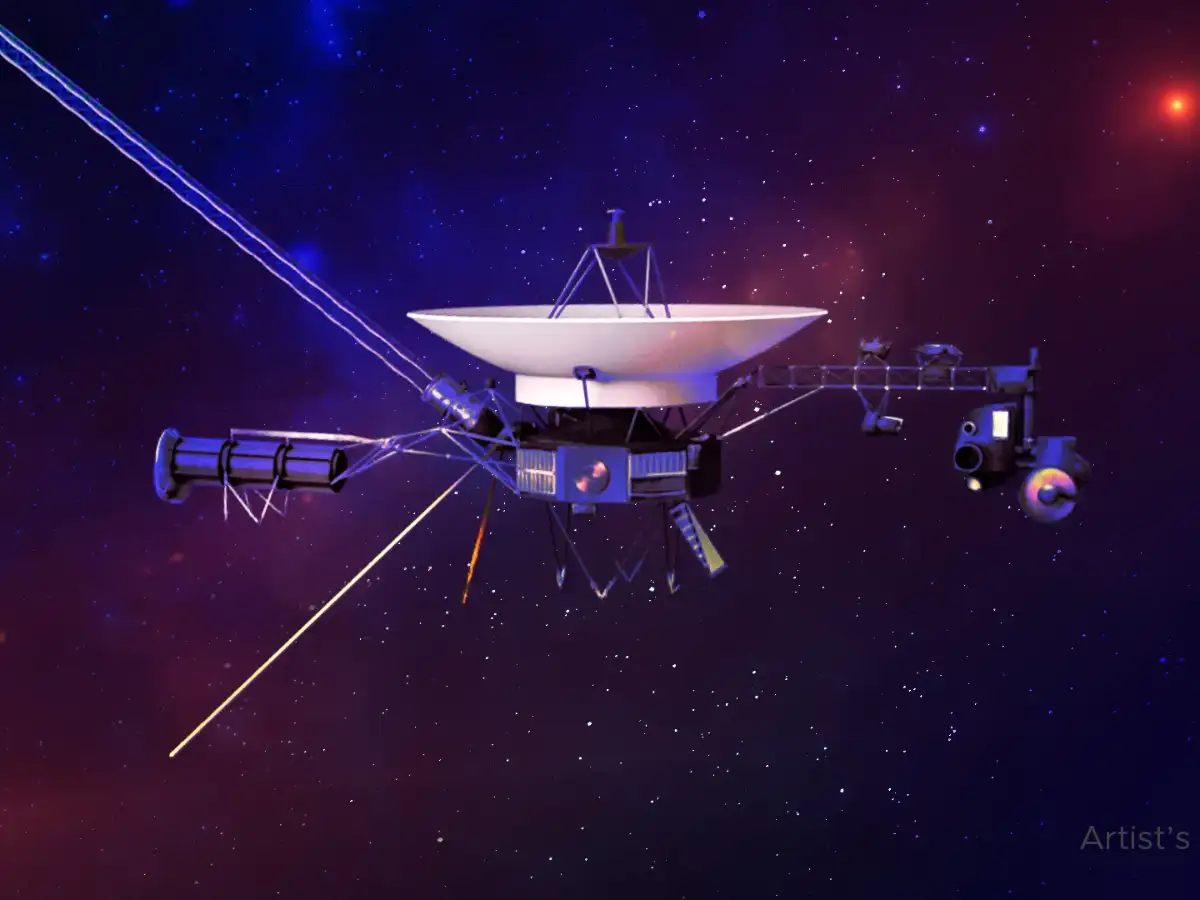
Voyager-1, launched in 1977, has long fascinated the scientific community and public alike. It now sits in interstellar space, beyond the heliopause—the boundary where solar wind from the Sun meets the interstellar medium. A recent claim suggests that data from Voyager-1 reveal a “blistering” plasma region at this boundary, hot enough and intense enough to force a major rewrite of how scientists understand the Sun’s magnetic environment and the shape of our cosmic bubble.
Let’s unpack what is credible, what is exaggerated, and what to watch.
What the Claim Says
The recent story makes the following assertions:
- At the heliopause, Voyager-1’s instruments have detected much higher densities and temperatures in the plasma than expected, so intense that the region is being called a “wall of fire.”
- It’s claimed that the Sun’s magnetic field lines are being compressed and stretched, leading to magnetic reconnection events—where the magnetic field snaps and reorganizes, releasing energy.
- The article further suggests that the magnetic field strength inside the heliopause resembles the field outside it in interstellar space more than expected, implying a smoother transition than standard models predict.
What We Can Confirm
From what is publicly known (through NASA and other peer-reviewed science):
- Voyager-1 is still sending back data, though not always fully nominal. Some instruments have degraded over time, and the power supply is diminishing. Despite this, it remains a valuable probe of interstellar space.
- Measurements at the heliopause region have long shown that particle density increases and cosmic ray flux changes significantly across that boundary. The interstellar medium is vastly different in conditions from the solar wind region.
- Magnetic fields behave in complex ways. When Voyager 1 crossed into interstellar space, the magnetic field strength measured did not drop the way many naive models predicted; instead, researchers have noted that some gradients are smoother, some more turbulent, and that there can be phenomena like fluctuations, “folds” in magnetic field lines, etc.
- Magnetic reconnection is a well-known process in astrophysics and space plasma physics. It happens around the Earth, in the Sun’s corona, and is believed to occur in boundaries like the heliopause due to the collision of different magnetic domains.
What Seems Exaggerated or Speculative
However, much of the claim in the “wall of fire” framing is likely speculative or taken out of proportion. Key exaggerations include:
- Temperature numbers like “30,000 °C” or “54,000 °F” are dramatic and evocative, but in plasma physics, temperature is often a measure of averaged particle energy—not like a flame or heat you’d feel. Also, density in such regions is extremely low, so “hot” doesn’t translate to “hot” in everyday terms.
- The term “wall of fire” suggests a sharp, intense barrier or flame-like structure, which doesn’t reflect how space plasmas work. Even with magnetic reconnection, the boundary is not a literal wall or a flame front.
- The claim that magnetic fields inside the heliopause look surprisingly similar to fields outside may be based on isolated or limited measurements. While there are similarities or smoother transitions, that does not yet overturn models that predict strong differences in plasma environment, particle flux, and magnetic field structure.
- Suggesting that all current solar boundary theories must be rewritten is premature. Science often adjusts with incremental updates rather than wholesale revolution.
What Scientists Are Investigating
These are the things researchers are actively exploring, which might lead to updates in our understanding (though not necessarily radical rewrites):
- Better modeling of the heliopause that accounts for turbulence, mixed plasma flows, and how interstellar medium interacts with the Sun’s magnetic influence.
- Measurements of particle energy, density, and magnetic field structure across different instruments aboard Voyager-1, as well as comparing to Voyager-2 (though the two probes are in different region trajectories).
- Understanding magnetic reconnection events in regions of space with mixed solar wind and interstellar plasma. How frequent are they near the boundary, what energy they release, and how they shape plasma distribution.
- Telemetry challenges from Voyager-1: Because power and instrument wear are real issues, some measurements may be noisier or degraded. Interpreting them correctly is nontrivial.
Conclusion: Big Ideas, But Still a Long Road
Voyager 1 continues to be one of humanity’s greatest scientific tools, pushing the frontier of what we know about cosmic boundaries. While the idea of a “wall of fire” at the heliopause is an attention-grabbing metaphor, the actual data do not yet support such dramatic language in scientific consensus.
What is true is that Voyager has recorded surprising behaviors in plasma density, magnetic field, and particle flow at our solar system’s edge—and those surprises help refine scientific models.
If you publish this topic, emphasizing what is verified vs what is speculative will help your audience discern fact from sensationalism.








Leave a Reply