

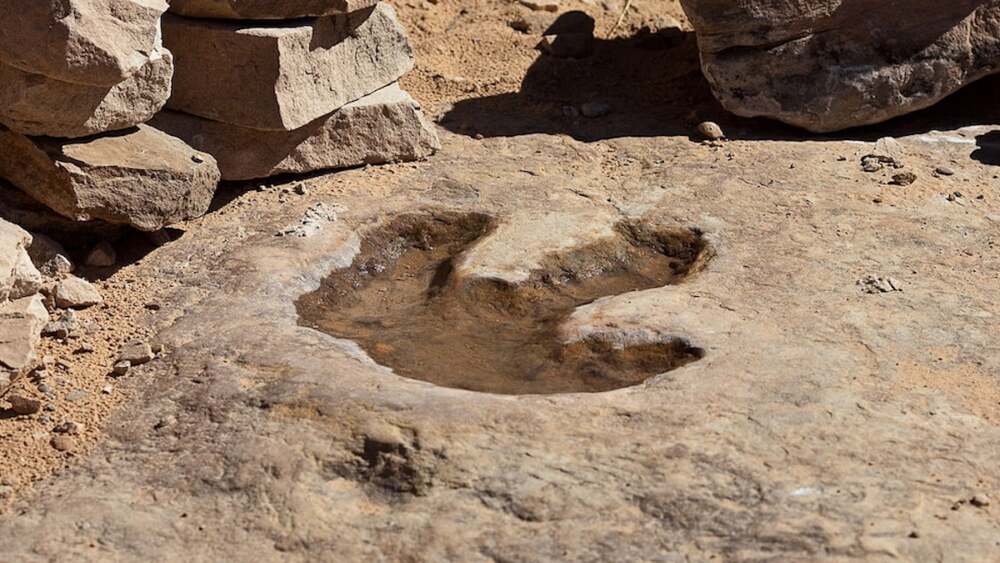
Paleontologists have announced the discovery of an astonishing 18,000 dinosaur tracks at what is now considered the largest dinosaur tracksite ever found. This remarkable location, sprawling across a previously unexplored sediment-rich region, offers one of the clearest windows into the daily lives, movement patterns, and ecological interactions of dinosaurs millions of years ago.
The newly uncovered tracksite captures a bustling prehistoric landscape frozen in stone. The footprints—varying in size, depth, and orientation—belong to a diverse array of species, from massive long-necked sauropods to sharp-clawed theropods and smaller herbivorous dinosaurs that once roamed ancient floodplains.
Scientists describe the site as a “snapshot in time,” representing a period when dinosaurs gathered around waterways, migrated in herds, or crossed muddy grounds in search of food. The sheer number of tracks, preserved in exquisite detail, is giving researchers unprecedented data on dinosaur behavior, including herd structure, walking speeds, and even potential predator–prey interactions.
Notably, the site also reveals parallel trackways suggesting coordinated group movement among large herbivores—supporting theories that some dinosaur species traveled together for protection and resource access. Likewise, clusters of juvenile footprints point toward family groupings and possible nurturing behaviors.
The extraordinary preservation is attributed to a combination of volcanic ash layers, sediment deposits, and rapid environmental changes that sealed the tracks before erosion could erase them. As scientists continue to excavate and digitally scan the footprints, they expect to reconstruct entire prehistoric scenes with near-cinematic precision.
Experts say the discovery dramatically expands our understanding of dinosaur ecosystems and may take decades to analyze fully due to its staggering scale. Already, the tracksite is being hailed as one of the most significant paleontological finds of the century.
For researchers and enthusiasts alike, the 18,000-track treasure trove serves as a reminder of just how much ancient Earth still has to reveal—and how each new discovery reshapes the story of life long before humans appeared.










Leave a Reply