

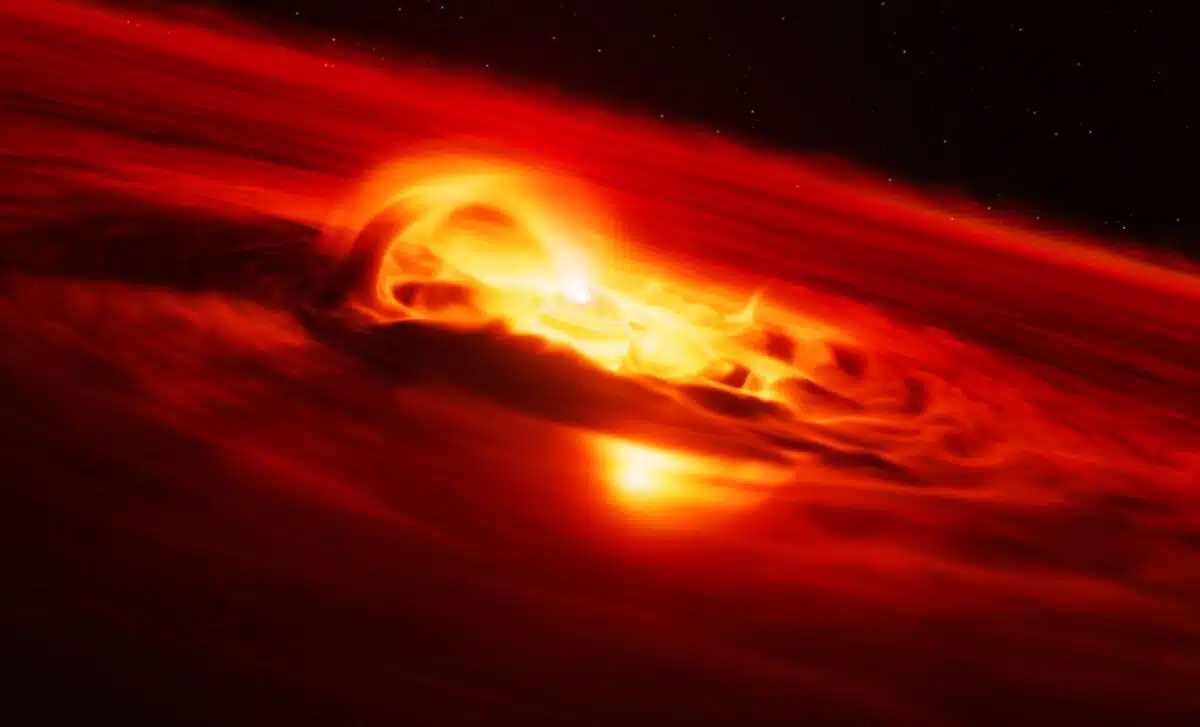
Astronomers have made a groundbreaking discovery that challenges our understanding of how planets form and evolve. Using advanced telescopic instruments, researchers have identified a young rogue planet—a free-floating world unbound to any star—that appears to be actively consuming gas and dust from its surroundings. This extraordinary find not only reshapes how scientists think about planetary formation but also raises fundamental questions about where the boundary truly lies between planets and stars.
A Lone Giant in Deep Space
The planet, known as Cha 1107-7626, lies approximately 620 light-years from Earth in the Chamaeleon constellation, a region rich in star-forming clouds. Unlike the planets in our solar system, which orbit the Sun, Cha 1107-7626 drifts alone through the interstellar medium, untethered to any star. It is believed to be between five and ten times the mass of Jupiter—making it a gas giant by classification, but one with mysterious origins.
What makes this planet truly remarkable is that it is still forming, pulling in massive quantities of material from a surrounding disk of gas and dust. Observations suggest that the planet is “feeding” on its environment at a rate of billions of tons per second, a phenomenon previously thought to be limited to young stars.
An Unexpected Burst of Growth
Astronomers using the European Southern Observatory’s Very Large Telescope (VLT) in Chile first detected unusual fluctuations in Cha 1107-7626’s brightness earlier this year. Follow-up spectroscopic studies revealed that the object was undergoing a powerful accretion burst—an event where the planet’s gravity pulls in surrounding matter at an accelerated pace.
During this burst, the rate of material falling onto the planet increased nearly eightfold, producing a bright flare that made it temporarily easier to study. These violent growth spurts are commonly seen in newly forming stars, but finding one in a planetary-mass object is exceedingly rare.
According to the research team, the rogue planet’s behavior blurs the line between stellar accretion and planetary formation—two processes previously considered distinct.
What Is a Rogue Planet?
A rogue planet, also known as a free-floating planet, is a planetary-mass body that does not orbit a star. Scientists have long debated how these wandering worlds form. Two main theories dominate the discussion:
- Ejection Theory: A planet forms around a star but is later ejected from its solar system by gravitational interactions with larger planets or passing stars.
- Direct Formation Theory: A planet forms independently, much like a small star, collapsing directly from a dense cloud of gas and dust.
The discovery of Cha 1107-7626 supports the second theory, showing that at least some rogue planets are capable of forming in isolation, surrounded by their own disks of material—much like miniature versions of star systems.
The Green Light of Accretion
Spectroscopic data collected from Cha 1107-7626 show that it is still surrounded by a dense accretion disk, a rotating halo of gas and dust spiraling toward the planet. The material is heated as it falls inward, creating powerful emissions that can be observed in infrared and visible wavelengths.
Interestingly, the team detected traces of water vapor and organic molecules in the disk—an indicator of complex chemical processes similar to those that occur in the disks around young stars. This means that even rogue planets might host prebiotic chemistry, suggesting that building blocks of life could exist far from the warmth of any star.
A Challenge to the Definition of a Planet
Traditionally, planets and stars have been defined by how they form. Stars emerge from collapsing clouds of gas massive enough to ignite nuclear fusion in their cores. Planets, on the other hand, form from the leftover debris orbiting a young star. But Cha 1107-7626 doesn’t fit neatly into either category.
It seems to have formed through direct gravitational collapse, like a star, but it lacks the mass needed to ignite hydrogen fusion. With roughly ten Jupiter masses, it sits on the edge between a massive planet and a brown dwarf—an object sometimes referred to as a “failed star.”
This discovery forces astronomers to re-examine long-held definitions. If planets can form independently in deep space and feed on material like stars, where does one category end and the other begin?
Cosmic Cannibal: A Planet That Eats to Grow
The phrase “planet eating its surroundings” might sound sensational, but it’s a literal description of what’s happening. Cha 1107-7626’s gravity is so strong that it’s actively pulling in material from a vast disk, consuming everything within reach. This process adds both mass and heat, fueling intense magnetic activity and high-energy emissions.
Astronomers estimate that the planet’s accretion rate peaked at six billion tons per second, an almost unimaginable figure. For comparison, that’s roughly equivalent to Earth’s entire atmosphere being swallowed every ten minutes.
The event may only last for a few thousand years—a blink of an eye in cosmic time—but during this period, the planet could gain enough mass to edge dangerously close to becoming a brown dwarf.
Technology Behind the Discovery
The breakthrough was made possible by advanced instruments such as spectrographs and infrared cameras capable of detecting subtle changes in brightness and heat. Observations from both ground-based and space telescopes were combined to confirm the findings.
The VLT’s powerful resolution allowed researchers to distinguish between light emitted from the planet itself and from its surrounding disk. These precision measurements gave scientists their first clear look at how a rogue planet accretes material—something previously seen only in simulations.
What This Means for Astronomy
This discovery marks a major milestone in our understanding of planetary evolution and cosmic diversity. It suggests that planets may form through more than one pathway and that the universe could be filled with unbound worlds quietly evolving in the darkness.
Key takeaways from the study include:
- Rogue planets may form independently, not just as ejected exoplanets.
- Planetary accretion can mirror stellar processes, suggesting a continuum of formation mechanisms.
- The presence of water vapor and organic compounds hints at chemically active disks around even isolated planets.
The implications extend far beyond astronomy—touching on questions about planetary habitability, the origins of chemical complexity, and the sheer variety of worlds that may populate our galaxy.
A Glimpse Into the Universe’s Creative Chaos
Cha 1107-7626 is a cosmic paradox: a planet acting like a star, forming in isolation yet bursting with the same dynamic energy that powers stellar nurseries. In observing it, astronomers are catching a rare glimpse of the universe’s creative chaos—a moment when gravity, chemistry, and time converge to shape a world unlike any other.
It reminds us that the universe doesn’t always adhere to our neat categories or definitions. Sometimes, it blurs the lines between stars and planets, forcing us to see creation not as a set of rigid stages, but as a continuum of cosmic evolution.










Leave a Reply