

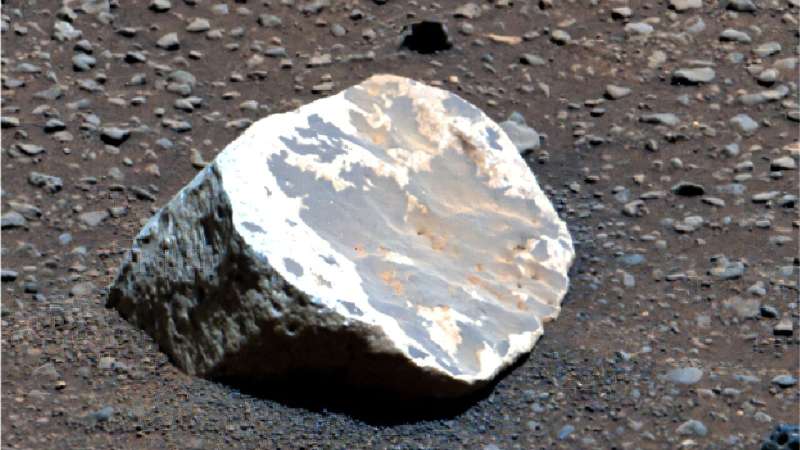
New research has provided compelling evidence that Mars may have experienced rain-driven climates in its distant past, based on the discovery of bleached rocks scattered across Jezero Crater. Scientists studying the region suggest that these altered rocks indicate the presence of liquid water in the form of rainfall, challenging previous notions that Mars’ ancient climate was dominated solely by rivers, lakes, or glacial activity.
Jezero Crater, the landing site of NASA’s Perseverance rover, has been a hotspot for investigating the Red Planet’s watery history. The recent analysis focuses on bleached or light-toned rock formations, which are believed to have undergone chemical alteration due to repeated exposure to water. Laboratory simulations and spectral studies indicate that this bleaching likely resulted from precipitation infiltrating the Martian surface, rather than only groundwater seepage or river runoff.
Dr. Elena Martinez, a planetary geologist involved in the study, explained: “These bleached rocks suggest that Mars had episodes of rainfall, possibly forming transient streams and contributing to sediment transport in ways we hadn’t fully appreciated before. This gives us a more dynamic picture of Mars’ early climate and water cycle.”
The findings carry significant implications for the search for past life on Mars. Rain-fed environments could have created more habitable conditions, distributing nutrients and sustaining microbial ecosystems more effectively than isolated water bodies alone. Moreover, understanding how precipitation interacted with the Martian surface helps scientists reconstruct the planet’s climate evolution, including periods of warming and cooling in its ancient past.
The discovery was made possible through a combination of high-resolution imagery, rover-based spectroscopy, and comparative analysis with Earth analogs. These methods allowed researchers to map the bleached areas and infer the chemical processes that created them, strengthening the case for precipitation-driven surface alteration.
As exploration continues in Jezero Crater, scientists hope to uncover additional evidence of Mars’ wetter periods. Each new finding brings humanity closer to understanding the Red Planet’s complex climate history and its potential for having supported life.














Leave a Reply