

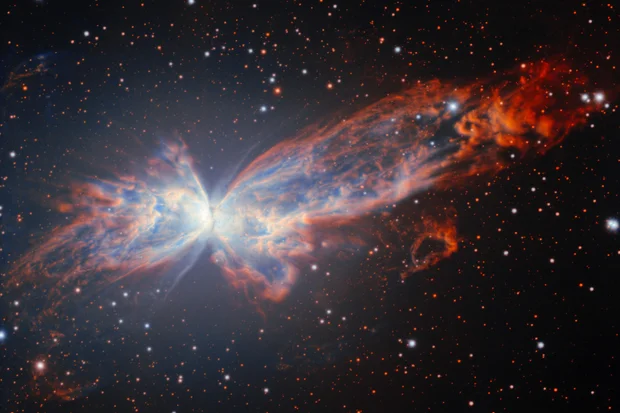
Astronomers have released a breathtaking new image of the well-known object NGC 6302 — commonly dubbed the “Cosmic Butterfly” or “Bug Nebula.” Captured by a powerful telescope in Chile, the photograph reveals dramatic details of the nebula’s striking bipolar structure: sweeping lobes of gas and dust that fan out like wings in deep space. The image showcases rich colors and fine structures, giving viewers a vivid glimpse into the turbulent final stages of a dying star.
What Is NGC 6302 — The Butterfly Nebula
NGC 6302 is a planetary nebula: the glowing shell of gas and dust ejected by a sun‑like star as it nears the end of its life. As the star sheds its outer layers, intense radiation lights up the expelled material, creating intricate and colorful shapes. In the case of NGC 6302, that material is cast into two broad lobes that stretch outward in opposite directions, giving the appearance of a butterfly’s wings — hence its nickname.
At the center lies the nebula’s remnant core, once a dying star, now an extremely hot white dwarf whose powerful ultraviolet radiation excites the surrounding gas and makes it glow in vivid hues.
Why the New Image is Special
The latest Chile‑telescope image of NGC 6302 stands out for several reasons:
- Extraordinary Detail: The photograph reveals delicate filaments, arcs, and layers of gas and dust that previous images didn’t show as clearly, highlighting the nebula’s complex structure.
- Vibrant Color Contrast: Different colors represent varying elements and temperatures — from glowing hydrogen to ionized oxygen and nitrogen — painting a rich portrait of the nebula’s composition and energetic processes.
- Dynamic Perspective: The clarity and resolution give a sense of depth and motion, as if the butterfly’s wings are spreading in real time — a reminder that space is not static, but shaped by powerful forces and time.
This level of detail gives both astronomers and space‑enthusiasts a chance to appreciate the beauty and violence of stellar death in vivid, almost surreal fashion.
What It Teaches Us — Stellar Death and Cosmic Recycling
Nebulae like NGC 6302 provide an important window into what happens when stars near the end of their lifecycles. When a star similar to our Sun exhausts its nuclear fuel, it sheds its outer layers, enriching interstellar space with heavy elements — carbon, oxygen, nitrogen — essential building blocks for future stars, planets, and potentially life.
Studying the shape, composition, and motion of the gas and dust in such nebulae helps scientists understand:
- How stellar winds and radiation shape the surrounding material;
- The chemical enrichment of the galaxy;
- The physics of gas ejection, ionization, and cooling in extreme conditions.
With each new image and new data set, astronomers refine models of how stars evolve and die, and how the elements necessary for planets — and life — are distributed across the cosmos.
Public Awe and Inspiration
The “Cosmic Butterfly” image captures the imagination — reminding people on Earth of both the grandeur and fragility of the universe. For amateur stargazers, students, educators, and anyone curious about space, the image serves as both science and art: a cosmic masterpiece that evokes wonder and curiosity.
Social media and astronomy groups are already sharing the photograph widely, using it to highlight the beauty of space and the importance of astronomical research. It’s a powerful example of how exploration and observation can spark inspiration beyond the scientific community.
Looking Ahead — What’s Next for NGC 6302 and Similar Nebulae
Astronomers plan to follow up with additional observations, using different wavelengths — infrared, radio, ultraviolet — to peer deeper into the nebula’s structure and composition. These studies may reveal hidden dust lanes, colder gas, and molecular clouds, offering insight into the full range of material ejected by the dying star.
Moreover, comparing NGC 6302 with other planetary nebulae will help scientists piece together a broader picture of stellar evolution and the ultimate fate of sun‑like stars. Each nebula carries its own history, and together they show the diversity of outcomes in stellar death.
The new “Cosmic Butterfly” image of NGC 6302 is more than a beautiful photo — it’s a vivid reminder of the continual cycle of creation and destruction in the universe. As dying stars cast off their outer shells, they seed future generations of stars and planets. And thanks to modern telescopes and dedicated astronomers, we get to watch the spectacle — in breathtaking color, scale, and detail.











Leave a Reply