

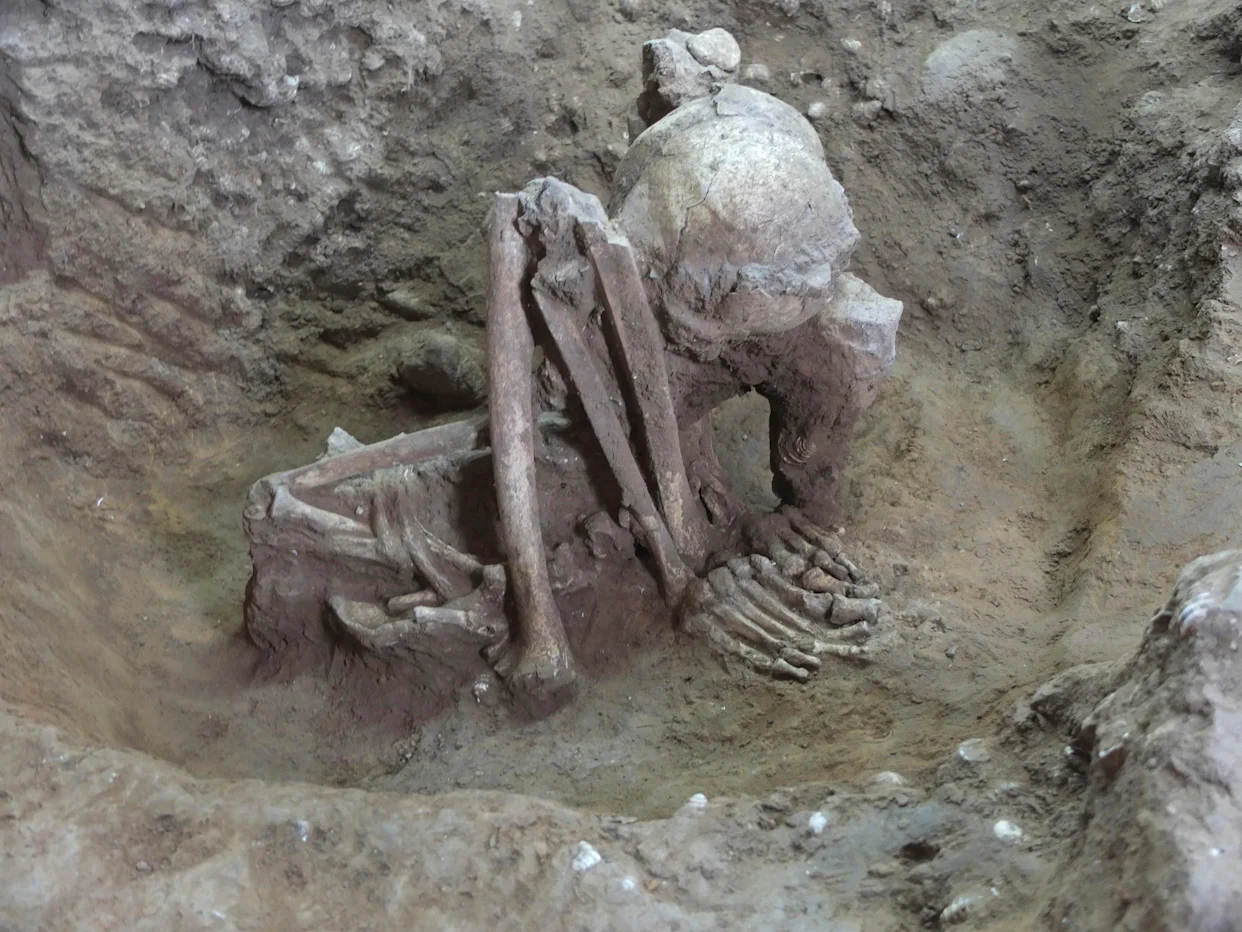
Southeast Asia / Southern China — A new archaeological study has identified what could be the oldest known evidence of human mummification, revealing that hunter-gatherer communities in Southeast Asia and southern China were practicing smoke-drying of human remains as far back as 12,000 years ago. The findings reshape our understanding of early funerary customs and show that mummification outside of Egypt and South America developed far earlier than previously believed.
Key Findings
- Human remains found at multiple ancient burial sites across southern China and Southeast Asia — including locations in Vietnam, Laos, Thailand, Malaysia, Indonesia, and the Philippines — show signs of being buried in crouched or squatting positions, coupled with cuts and burn marks. These features indicate they may have been deliberately prepared after death.
- Bone analysis reveals structural changes consistent with exposure to low-intensity heat or smoke, rather than full cremation. Evidence of soot, discoloration, and charred patches on skulls and other bones suggest bodies were smoke‐dried over fire.
- The researchers examined dozens of individuals, with dates ranging from roughly 12,000 to 4,000 years ago, pushing the origin of mummification back at least several thousand years compared to the previously known earliest practices.
Significance & Cultural Insights
- This discovery suggests that ancient people in these regions had sophisticated mortuary traditions, involving not just burial but also a process to preserve the body, likely for spiritual, commemorative, or ancestral reasons.
- The practice may have been ritualistic, serving to maintain connections with ancestors, and possibly allowing relatives to carry deceased individuals or retain them over time.
- Some Indigenous communities in the present era still use similar methods of smoke-drying and binding bodies, indicating a remarkable cultural continuity across millennia.
Scholarly Caution & Open Questions
- While the findings are striking, some experts urge caution: dating techniques need further cross-validation, and it is not yet fully clear how uniform or widespread the smoke-drying practices were across all sites.
- It remains uncertain how long the preservation lasted in each case, whether soft tissue survived in any form, or whether other preservation methods supplemented the smoke-drying.
- The social, ritual, or symbolic meanings behind the practice are still being decoded: for example, why some bodies were treated this way and others not, and what beliefs underpinned the practice.
Broader Implications
- By dating mummification to such an early period in Asia, the study alters the timeline of human funerary innovation. It offers new evidence that memory, ancestral reverence, and complex mortuary behavior were practiced by prehistoric hunter-gatherers much earlier than assumed.
- The discovery also contributes to models of human migration, culture, and the development of ritual. It raises the possibility that mummification practices spread or evolved independently in multiple regions.
Conclusion
The revelation of smoke-dried human remains in Asia dating back up to 12,000 years marks one of the most significant archaeological findings in recent years. It reframes the origins of mummification, showing it did not wait for large, settled states or agricultural societies to emerge, but was part of the ritual life of early human communities. As further research refines the details, this discovery opens new windows into understanding how ancient peoples dealt with life, death, memory, and reverence for their ancestors.















Leave a Reply