

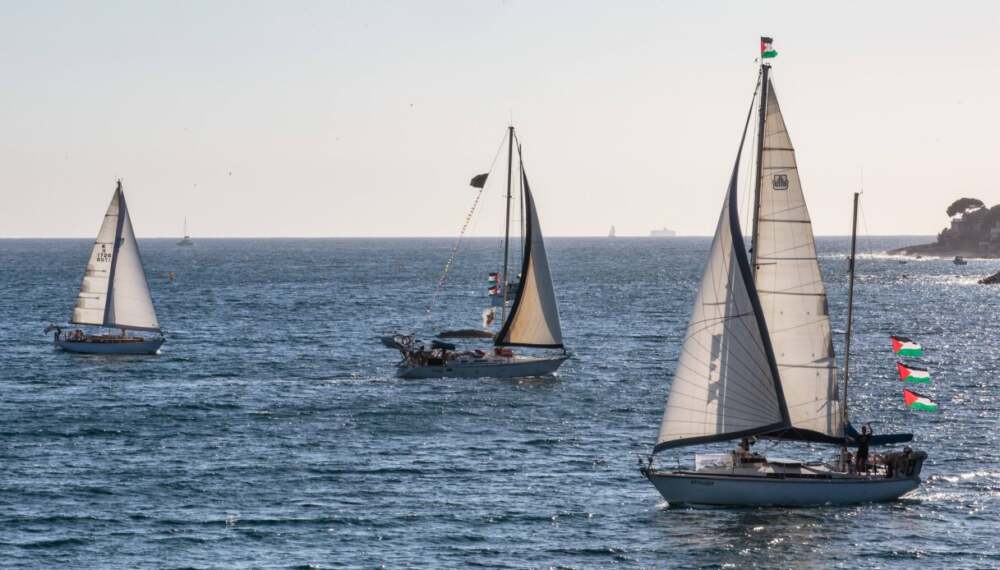
The arrival of the Global Sumud Flotilla in the eastern Mediterranean has renewed global attention on Israel’s naval blockade of Gaza and the broader question of whether such restrictions conform to international law. Comprised of more than 40 vessels carrying around 500 participants from over 40 countries, the flotilla has set sail with a dual purpose: delivering humanitarian supplies and directly challenging the legality of Israel’s maritime enforcement.
A Coalition of Civilian Vessels
The flotilla includes a diverse mix of ships—fishing boats, sailing yachts, and small freighters—bearing flags of multiple nations. Its participants are equally varied, encompassing doctors, lawyers, religious leaders, environmental activists, and human rights advocates. Many describe their participation as a moral duty, insisting that direct delivery of aid by sea is necessary given the repeated restrictions and delays imposed on humanitarian convoys entering Gaza by land.
Organizers emphasize that their mission is peaceful. Volunteers have undergone nonviolent resistance training, learned safety protocols for potential Israeli boarding operations, and been instructed on how to respond calmly to detention. The flotilla’s leaders argue that transparency in their preparations underscores their intention to challenge the blockade legally and morally, not militarily.
The Legal Battle at Sea
At the heart of the controversy is whether Israel’s blockade and its practice of intercepting vessels in international waters stand on firm legal ground.
- International Maritime Law: According to the United Nations Convention on the Law of the Sea (UNCLOS), all ships enjoy the right of free passage on the high seas. Any interference by a foreign power is heavily restricted, unless piracy, slavery, or unauthorized broadcasting is involved. Activists argue that stopping civilian aid boats far from Israeli territorial waters violates this principle.
- San Remo Manual on Armed Conflicts at Sea: This document, often cited by Israel, allows naval blockades under certain conditions. However, it also states that a blockade cannot be maintained if it disproportionately harms civilians by denying essential supplies. Critics say Israel’s enforcement has gone beyond legitimate security needs, effectively strangling Gaza’s economy and humanitarian lifelines.
- International Court of Justice Precedents: In recent rulings, the ICJ has reaffirmed that humanitarian access cannot be obstructed during times of armed conflict. Flotilla organizers point to these rulings as a legal shield, claiming Israel’s blockade contradicts binding international orders.
Israel’s Position
Israeli authorities insist the naval blockade is lawful, describing it as a defensive measure to prevent weapons smuggling to Hamas and other militant groups. Israel maintains the blockade has been declared, is enforced effectively, and complies with international law regarding armed conflicts.
Officials argue that the flotilla is a political stunt, intended not to provide aid but to provoke confrontation and delegitimize Israel. They emphasize that Israel has offered flotilla vessels the option to dock at Ashkelon or other designated ports, unload their cargo under supervision, and then have the supplies transported to Gaza through established land crossings.
Echoes of the Mavi Marmara
The current flotilla cannot escape comparisons with the 2010 Mavi Marmara incident, when Israeli commandos raided a Turkish vessel attempting to break the blockade. That raid left nine activists dead and sparked international outrage. A subsequent United Nations investigation concluded that while Israel’s blockade may have been lawful under international law, its enforcement in international waters and the use of lethal force raised serious legal and ethical concerns.
The memory of that deadly raid has fueled both determination and caution among Global Sumud organizers. They stress that their mission is nonviolent and symbolic, yet they are prepared for possible detention or interception.
International Reactions
Global responses to the flotilla reflect the deep divisions over Israel’s policies toward Gaza.
- Turkey, Qatar, and several European MPs have expressed sympathy for the mission, praising its emphasis on humanitarian relief and civil society solidarity.
- The United States and European Union, while critical of Gaza’s humanitarian crisis, have largely refrained from endorsing the flotilla, instead urging both sides to avoid escalation.
- Human rights groups including Amnesty International and Doctors Without Borders have used the flotilla’s voyage to highlight what they call the “collective punishment” of Gaza’s 2.3 million residents under siege.
Symbolism on the High Seas
Beyond its legal and political implications, the flotilla carries powerful symbolic weight. The word “Sumud” means “steadfastness” in Arabic—a reflection of the activists’ determination to resist what they view as unjust restrictions. For Gaza’s residents, many of whom face shortages of food, clean water, medicine, and fuel, the voyage represents a rare gesture of solidarity from the outside world.
The flotilla also tests the global community’s willingness to confront Israel on its interpretation of international law. If Israel intercepts the ships again, questions will inevitably arise over the legality of actions in international waters and the treatment of nonviolent civilians at sea.
Risks Ahead
Despite the flotilla’s emphasis on peace, risks remain high. Interceptions in the open sea can lead to dangerous confrontations. Past flotillas have reported aggressive tactics such as jamming communications, blocking GPS signals, and high-speed approaches by Israeli naval vessels. Any mishap could spark another diplomatic crisis, especially given the multinational composition of the flotilla’s passengers.
Conclusion
The Global Sumud Flotilla has already succeeded in one respect: placing Gaza’s humanitarian crisis and the legality of Israel’s blockade back in the global spotlight. Whether it reaches Gaza’s shores or is intercepted at sea, its voyage forces difficult questions about the balance between security and human rights, sovereignty and humanitarian access, law and morality.
As the ships continue their course, the eyes of the world remain fixed on the waters of the eastern Mediterranean—where the boundaries of international law and political will may soon be tested once again.












Leave a Reply