

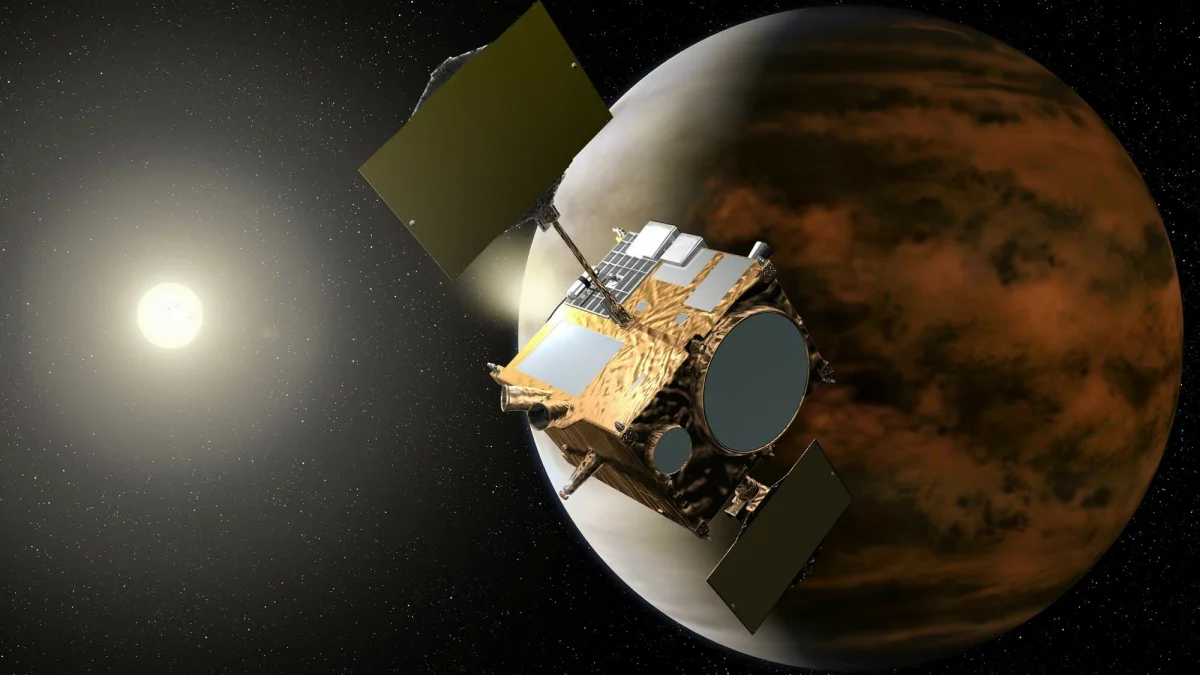
The Japan Aerospace Exploration Agency (JAXA) has officially concluded its 15-year mission with the Akatsuki spacecraft, marking the end of one of the most unique space missions in recent history. Launched on May 21, 2010, Akatsuki was designed to study Venus, providing unprecedented insight into the planet’s atmosphere, weather patterns, and mysterious super-rotating winds.
What set Akatsuki apart was more than its scientific goals. In a cultural first, the spacecraft carried over 13,000 fan-submitted drawings and messages of Hatsune Miku, the globally popular virtual pop star. These messages were etched onto small aluminum plates attached to the spacecraft, allowing fans to symbolically send their beloved digital idol into space. This blend of pop culture and space science captured the imagination of fans worldwide and made Akatsuki a mission with both scientific and cultural significance.
A Rocky Start and Triumph
Akatsuki’s journey to Venus was far from smooth. Shortly after its launch, the spacecraft’s main engine failed during its first attempt to enter Venus orbit in December 2010. This was a serious setback, leaving the mission’s future uncertain. However, JAXA engineers demonstrated remarkable ingenuity by devising an alternative plan using the probe’s smaller attitude control thrusters to correct its trajectory. Five years later, in December 2015, Akatsuki successfully entered orbit around Venus, demonstrating resilience and engineering prowess.
Once in orbit, Akatsuki began capturing high-resolution images of Venus, revealing its dense cloud cover and dynamic atmosphere. The probe provided critical data on the planet’s super-rotating winds, which can travel at speeds over 300 kilometers per hour, as well as insights into atmospheric phenomena such as polar vortices and gravity waves. These findings have been instrumental in advancing understanding of planetary atmospheres and comparative climatology between Earth and Venus.
A Cultural Touch in Space
The Hatsune Miku project made Akatsuki particularly memorable beyond the scientific community. Fans worldwide submitted drawings, messages, and wishes for the virtual pop star, which were then engraved onto aluminum plates and carried onboard the spacecraft. This unique gesture created a symbolic bridge between the worlds of space exploration and pop culture fandom, demonstrating how science can engage the public in imaginative ways.
The project reflected a growing trend in space missions that combine public outreach with technical achievements, providing enthusiasts with a tangible connection to exploration. For many fans, seeing Miku’s messages orbiting another planet was a powerful symbol of creativity meeting science.
The End of a Mission
In April 2024, JAXA lost communication with Akatsuki. Despite rigorous attempts to reestablish contact, it became clear that restoring operations would be extremely difficult. On September 18, 2025, JAXA officially concluded the mission, closing a chapter on a spacecraft that had not only advanced human understanding of Venus but had also carried the hopes and creativity of fans across the globe.
Legacy and Impact
Akatsuki leaves behind an enduring legacy. Scientifically, it has provided invaluable data on Venus’s atmosphere, contributing to ongoing studies on planetary weather systems, climate, and the evolution of terrestrial planets. Its observations continue to inform future missions, including planned explorations of Venus and other inner planets.
Culturally, the mission stands as a testament to the power of engaging the public in space exploration. The Hatsune Miku project demonstrated that space missions need not be purely technical endeavors—they can inspire, delight, and connect people worldwide in meaningful ways.
Looking Forward
While Akatsuki’s mission has officially ended, JAXA and other space agencies are already planning the next generation of planetary exploration missions. The success of Akatsuki highlights the importance of creativity, persistence, and public engagement in science. The spacecraft may no longer be transmitting data, but the spirit of its journey—and the messages of thousands of fans—will orbit in human memory for years to come.
Akatsuki’s story serves as a reminder that space exploration is not just about discovery; it’s also about imagination, inspiration, and connecting humanity with the vast universe beyond our planet.
















Leave a Reply