


In one of the most ambitious corporate initiatives in recent U.S. history, JPMorgan Chase has announced a decade-long plan to invest and mobilize $1.5 trillion into industries deemed essential to America’s economic and national security. The new program, called the Security and Resiliency Initiative, aims to reinforce domestic supply chains, reduce foreign dependency, and strengthen the United States’ position in a rapidly evolving global economy.
A Vision Rooted in Security and Economic Strength
At the heart of JPMorgan’s announcement is a belief that national strength and economic resilience are inseparable. The bank’s Chairman and CEO, Jamie Dimon, framed the initiative as both an economic and patriotic endeavor, declaring that “America’s security is predicated on the strength and resiliency of its economy.”
Dimon emphasized that the U.S. must accelerate investment, streamline regulations, and modernize its workforce if it intends to maintain global leadership. “We need to remove the obstacles that stand in the way—excessive regulation, political gridlock, and outdated education systems that don’t produce the skills we need,” he said.
The new initiative comes at a time when nations are racing to control the supply of critical materials, energy resources, and emerging technologies that will define the 21st century. With geopolitical tensions high and global trade realignments underway, JPMorgan’s plan signals that the private sector is taking a direct role in safeguarding national resilience.
Four Strategic Pillars of the Plan
The Security and Resiliency Initiative will focus on four core sectors—each representing a foundation of modern economic and defense stability.
- Supply Chain and Advanced Manufacturing
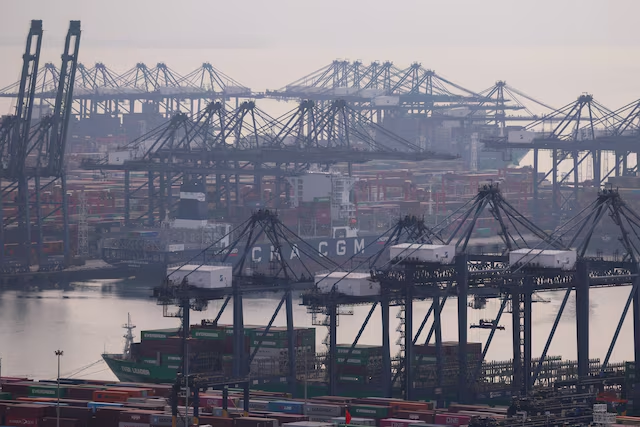
JPMorgan will channel financing into companies that produce critical inputs such as semiconductors, pharmaceutical precursors, rare earth minerals, robotics, and industrial components. The aim is to rebuild domestic production capacity and reduce dependency on foreign sources. - Defense and Aerospace
The bank plans to invest in emerging defense technologies—ranging from autonomous systems to secure communications and precision manufacturing. This focus aligns closely with U.S. efforts to modernize its military and enhance deterrence capabilities in the Indo-Pacific and beyond. - Energy Independence and Infrastructure Resilience
As climate disruptions and geopolitical shocks strain global energy systems, JPMorgan’s initiative will target grid modernization, battery storage, nuclear innovation, and distributed renewable energy projects. These efforts seek to harden U.S. infrastructure against both environmental and cyber threats. - Frontier and Strategic Technologies
The bank intends to support breakthrough innovations in AI, quantum computing, cybersecurity, advanced materials, and biotechnology, seeing these as key to maintaining technological leadership.
Within these pillars, the firm has identified 27 sub-industries where capital infusions, strategic guidance, and private-public collaboration could yield the greatest long-term impact.
Financial Commitment and Implementation Framework
JPMorgan plans to deploy $10 billion in direct equity investments as part of the initiative. The remainder of the $1.5 trillion will be mobilized through financing, lending, and advisory services over the next decade.
This hybrid model allows the bank to amplify its impact—providing capital while also advising firms on expansion, innovation, and compliance with emerging national standards.
To ensure effective execution, the bank will create an external advisory council made up of business, defense, and policy leaders. The council’s role will be to guide investment priorities and align them with U.S. national interests.
JPMorgan also announced a wave of strategic hiring—including engineers, economists, cybersecurity experts, and policy specialists—to strengthen its internal capacity for evaluating high-technology and industrial investments.
A Broader Economic Context
The announcement comes amid a global economic transformation in which security and supply chain control have become central to economic strategy. The COVID-19 pandemic, followed by geopolitical flashpoints such as the war in Ukraine and rising tensions in the South China Sea, exposed how fragile global dependencies could become in times of crisis.
For Washington, these shocks have reinforced the need to rebuild industrial self-sufficiency—a goal echoed in initiatives like the CHIPS and Science Act, the Inflation Reduction Act, and Defense Production Act expansions. JPMorgan’s move represents a major private-sector complement to those federal efforts.
Economists describe this as a shift toward “resilient capitalism”—where the pursuit of profit aligns with the pursuit of national security and economic sovereignty.
Jamie Dimon’s Broader Message
For Jamie Dimon, this initiative extends beyond financial ambition—it’s a call for long-term vision in an era of short-term politics. Dimon has repeatedly warned that America’s global leadership is being tested by rising competition, outdated infrastructure, and complacency.
In his latest statement, he stressed that private capital must step up where government efforts alone may fall short:
“Our role as a financial institution is not just to fund growth—it’s to strengthen the foundation of the nation that enables that growth. This initiative is about ensuring America remains strong, innovative, and secure for generations.”
Dimon also hinted that regulatory reform would be essential to ensure the plan’s success, noting that industrial projects often face years of permitting delays.
Potential Impacts on Industry and Policy
If successful, JPMorgan’s initiative could have ripple effects across multiple sectors:
- Manufacturing Revival: The influx of capital could rejuvenate U.S. factories, spur innovation in robotics and automation, and create thousands of high-skill jobs.
- Defense Modernization: Enhanced funding for aerospace and defense startups could accelerate the development of next-generation systems.
- Energy Transition: Investments in energy storage and grid resilience could help stabilize the renewable transition and protect against cyber threats.
- Tech Leadership: Support for AI and quantum computing may strengthen America’s edge in digital infrastructure and security.
Policy experts also note that the initiative could serve as a template for future private-public partnerships, blurring the lines between Wall Street and Washington in pursuit of shared strategic objectives.
Challenges and Criticisms
Despite its promise, the plan faces several challenges. Regulatory barriers, geopolitical uncertainties, and global competition could complicate its rollout. Critics warn that without transparency and accountability, the initiative could inadvertently favor certain industries or corporations over others.
Additionally, questions remain about how the $1.5 trillion figure will be structured and tracked—since much of it will likely involve facilitative financing rather than direct spending.
Still, even skeptics acknowledge the symbolic and practical weight of JPMorgan’s move. It signals that corporate America is taking an active role in shaping national resilience, not merely responding to market demand.
The Next Decade: A Defining Test
Over the next ten years, the Security and Resiliency Initiative will serve as a test of whether finance can be a tool of national renewal. If executed effectively, it could transform key sectors of the U.S. economy—rebuilding industrial strength, fostering innovation, and ensuring that the country can stand independently in a turbulent world.
In essence, JPMorgan Chase is betting not just on profit, but on America’s capacity to reinvent itself.
















Leave a Reply