


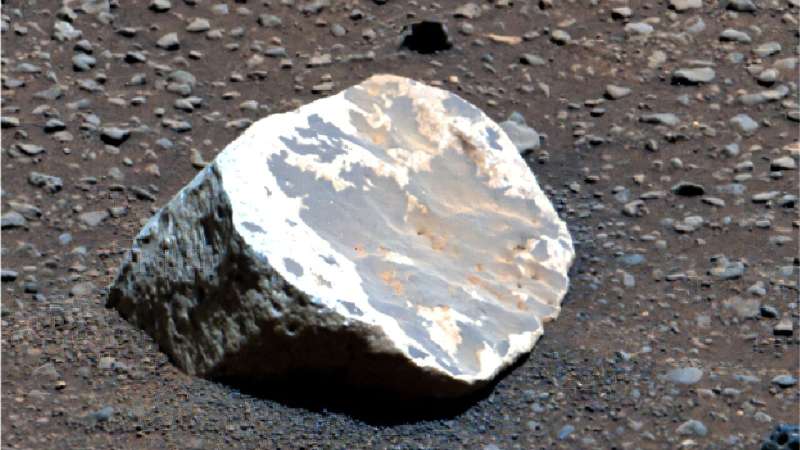
A remarkable discovery has emerged from what had been regarded for nearly two decades as an ordinary gold nugget — but recent expert analysis has revealed that the object is in fact a meteorite formed around 4.6 billion years ago, offering a rare glimpse into the early history of our solar system.
From Treasure to Space Rock
For 17 years, the rock sat tucked away in a private collection, appreciated for its rough, dense appearance and assumed golden sheen — enough to be considered a substantial nugget of precious metal. Its owner treated it as a keepsake rather than a valuable mineral find. Over time, rumors circulated that it might be more than a chunk of gold, but no one took action — until recently.
Intrigued by its unusual weight-to-size ratio and strange internal structure, the owner submitted the specimen to a team of planetary geologists and meteoritic experts for testing. The results stunned everyone: rather than solid gold, the sample’s composition and isotopic signature matched those typical of primitive meteorites — ancient fragments from the early solar system.
What the Analysis Revealed
Detailed laboratory tests, including mineralogical examination and isotopic dating, showed the rock contains minerals and metals in proportions not typical of terrestrial gold nuggets. Instead, its composition mirrors that of known meteorites: metallic iron‑nickel phases, trace elements, and structural patterns that form under the conditions of space, not Earth.
More importantly, radioisotope dating placed the meteorite’s age at about 4.6 billion years — aligning with estimates for the age of the solar system itself. This suggests the meteorite likely formed during the very early stages of planetary creation, before Earth coalesced into its present form.
Why It Matters — Rare Window into Solar System History
Meteorites of such ancient origin are exceedingly rare, and each one represents a precious time capsule from the dawn of our cosmic neighborhood. This one, hidden for years as a “gold nugget,” offers scientists a chance to study physical and chemical conditions from the solar system’s infancy — information that can improve understanding of how planets, including Earth, formed and evolved.
Because the meteorite survived 4.6 billion years and finally came to light accidentally, it adds to a small but vital collection of primordial material available for study. Its discovery may offer insight into the distribution of metals and minerals in the earliest solar nebula, and help refine models of planetary formation.
Implications & What’s Next
Researchers plan to conduct further detailed study of the meteorite — including micro‑scale mineral analyses and isotopic mapping — to glean more information about early solar system chemistry. They’ll be looking for clues about the environment in which the meteorite formed, such as the temperature, pressure, and elemental mix of the early solar nebula.
Meanwhile, the story serves as a reminder that “ordinary” rocks can hold extraordinary secrets. Scientists are urging mineral collectors, hobbyists, and even ordinary rock‑finders to consider submitting unusual finds for professional analysis — you never know what may turn out to be a relic of deep space.
Conclusion
What began as a seemingly mundane treasure hunt has turned into a remarkable stroke of cosmic luck: a 17‑year‑old “gold nugget” revealed to be a 4.6‑billion‑year-old meteorite. In that moment, a private curiosity became a scientific artifact — a direct physical link to the origins of the solar system. As researchers begin to uncover its secrets, this unassuming rock may well change what we know about the birth of planets, including our own.











Leave a Reply