

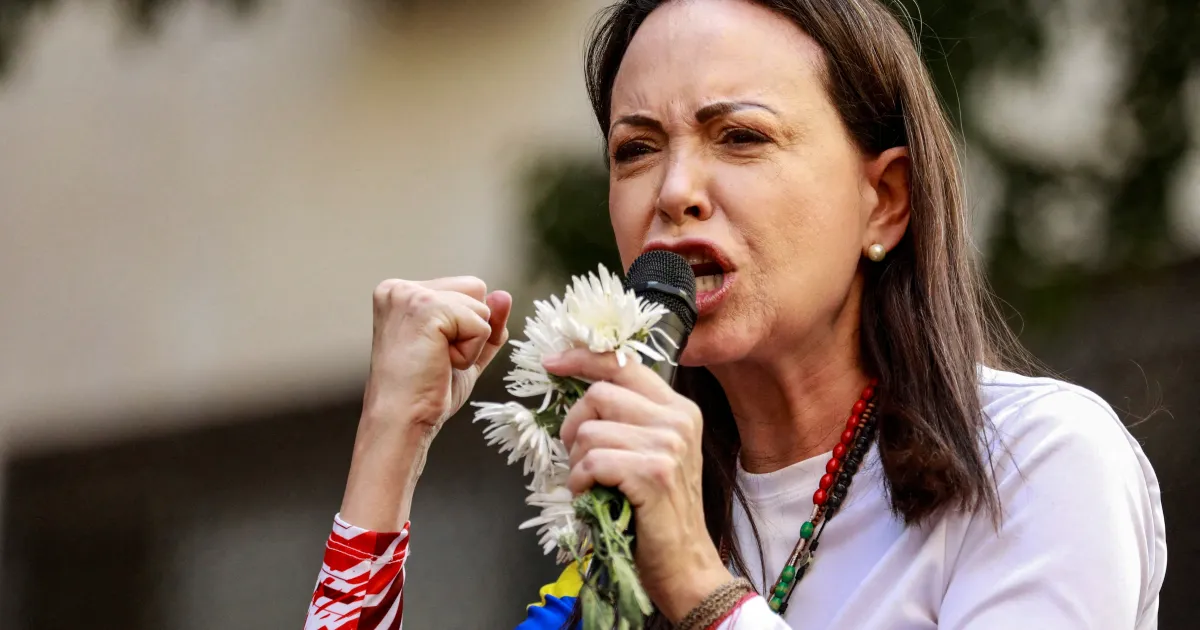
Oslo, October 10, 2025
The 2025 Nobel Peace Prize has been awarded to Maria Corina Machado, the Venezuelan opposition leader who has become a symbol of democratic resistance against authoritarianism in her country. The Norwegian Nobel Committee announced the decision in Oslo, recognizing Machado for her “unwavering commitment to democracy, human rights, and peaceful change” in one of Latin America’s most politically turbulent nations.
The award, one of the most anticipated in recent years, comes at a time when global attention has been distracted by ongoing geopolitical conflicts and the political drama surrounding former U.S. President Donald Trump’s repeated public claims that he should receive the prize. Yet the committee’s choice of Machado sends a clear message that the Peace Prize remains grounded in the principles of courage, freedom, and nonviolent struggle.
A Courageous Defender of Democracy
Maria Corina Machado, 58, has been one of the most prominent figures opposing Venezuela’s authoritarian government led by President Nicolás Maduro. For over two decades, she has called for free elections, the restoration of democratic institutions, and the release of political prisoners.
Her outspoken criticism of the regime has come at great personal cost. Machado has faced arrests, harassment, censorship, and multiple bans from holding public office. In 2024, she was officially disqualified from running in Venezuela’s presidential election despite being the most popular opposition candidate, according to independent polls.
Rather than silencing her, the ban galvanized her support both inside Venezuela and across the international community. Even while in hiding, Machado continued to rally her followers, calling for nonviolent resistance and international pressure on the Maduro regime.
Upon hearing the news of her Nobel Peace Prize win, Machado reportedly expressed disbelief. “Oh my God, I have no words,” she said in an emotional phone call with the Nobel Committee. “I don’t deserve this.” Her humility stood in sharp contrast to the global attention surrounding the announcement.
First Venezuelan to Receive the Peace Prize
Machado’s victory marks a historic milestone for Venezuela, making her the first Venezuelan citizen to receive the Nobel Peace Prize. She is also only the sixth Latin American laureate in the award’s history.
In its official statement, the Norwegian Nobel Committee praised Machado for representing “the peaceful aspirations of millions of Venezuelans who continue to seek freedom through democratic means.”
Committee Chair Joergen Watne Frydnes said the decision was made to highlight the importance of courage and persistence in the face of repression. “Maria Corina Machado embodies the spirit of peaceful resistance,” he said. “Her struggle is not only for Venezuela but for all who believe that democracy can prevail through nonviolence.”
A Message to Authoritarians Worldwide
The decision to honor Machado carries a broader symbolic weight. It is widely interpreted as a direct rebuke to authoritarianism at a time when democracy is under pressure around the globe—from Venezuela and Nicaragua to Russia, Myanmar, and beyond.
The committee’s choice also signals support for political dissidents who continue to fight for human rights despite imprisonment, exile, or intimidation. Machado now joins a prestigious group of laureates—including Nelson Mandela, Aung San Suu Kyi, and Malala Yousafzai—whose personal struggles have come to define the global fight for freedom and justice.
Analysts believe the award could inspire renewed momentum for Venezuela’s fractured opposition, which has struggled for years to unite against Maduro’s entrenched rule. However, it may also provoke a backlash from the government in Caracas, which has consistently dismissed foreign criticism as “imperialist interference.”
The Prize Overshadowed by Global Politics
This year’s Nobel Peace Prize was announced against a backdrop of unusual political noise. Former U.S. President Donald Trump had publicly declared that he should be the recipient of the 2025 prize, citing his role in recent diplomatic efforts and peace negotiations. His claims drew both ridicule and controversy, leading many observers to warn that the award’s credibility could be undermined by political grandstanding.
By awarding the prize to Machado, the Nobel Committee has effectively reasserted its independence and reaffirmed its commitment to the prize’s founding ideals—rewarding moral courage and peaceful activism over political spectacle.
Observers also noted that the committee’s deliberations took place before the latest ceasefire deal and hostage-release agreement related to the Gaza conflict, another development that had been widely speculated to influence this year’s award.
A Dangerous Path Ahead
While the Nobel Peace Prize brings international prestige, it may also increase the risks Machado faces in Venezuela. Members of her political movement have already been targeted by authorities; several are currently taking refuge inside the Argentine embassy in Caracas to avoid arrest.
Human rights organizations, including Amnesty International and Human Rights Watch, praised the Nobel Committee’s decision but warned that the international community must now ensure Machado’s safety and maintain pressure on Maduro’s regime.
“Recognition must be followed by protection,” one human rights lawyer said. “This prize gives hope, but it also paints a target on her back.”
Whether Machado will be able to attend the December 10 award ceremony in Oslo remains unclear. If she is unable to travel due to security or political restrictions, she will join a short list of laureates—including Andrei Sakharov in 1975, Lech Wałęsa in 1983, and Aung San Suu Kyi in 1991—who were prevented from accepting their awards in person.
A Symbol of Hope for a Nation in Crisis
Venezuela remains a country in deep crisis. Years of economic collapse, hyperinflation, and corruption have forced millions to flee, creating one of the largest migration waves in modern Latin American history. Power shortages, food scarcity, and the breakdown of basic services continue to plague those who remain.
For many Venezuelans, Machado’s Nobel Prize represents not only recognition of one woman’s courage but also a rare moment of validation for an entire nation’s suffering and resilience. Social media platforms in Latin America were flooded with messages of celebration, pride, and tears.
“This award belongs to all Venezuelans who never stopped believing in freedom,” one supporter wrote.
What Comes Next
The Nobel Peace Prize includes a cash award of 11 million Swedish kronor—about 1.2 million U.S. dollars—which Machado has pledged to donate to humanitarian efforts supporting Venezuelan families and political prisoners.
Analysts say the award could strengthen international diplomatic pressure on Caracas, potentially leading to renewed talks about fair elections and human rights. But history shows that symbolic victories do not always translate into immediate change.
Even so, the global spotlight now shining on Venezuela offers a glimmer of hope that the international community will not look away from its ongoing struggle for democracy.
As Machado herself once said, “Dictatorships survive on silence. The moment the world listens, their power begins to fade.”
A Prize That Speaks Beyond Borders
In a year marked by wars, political polarization, and global uncertainty, the Nobel Committee’s choice to honor a peaceful dissident over powerful political figures underscores a timeless truth: genuine peace begins with the courage to speak out against oppression.
Maria Corina Machado’s Nobel Peace Prize is not just an honor—it is a statement. A statement that democracy, however fragile, still matters. And that the quiet bravery of one woman can echo louder than the rhetoric of the powerful.








Leave a Reply