

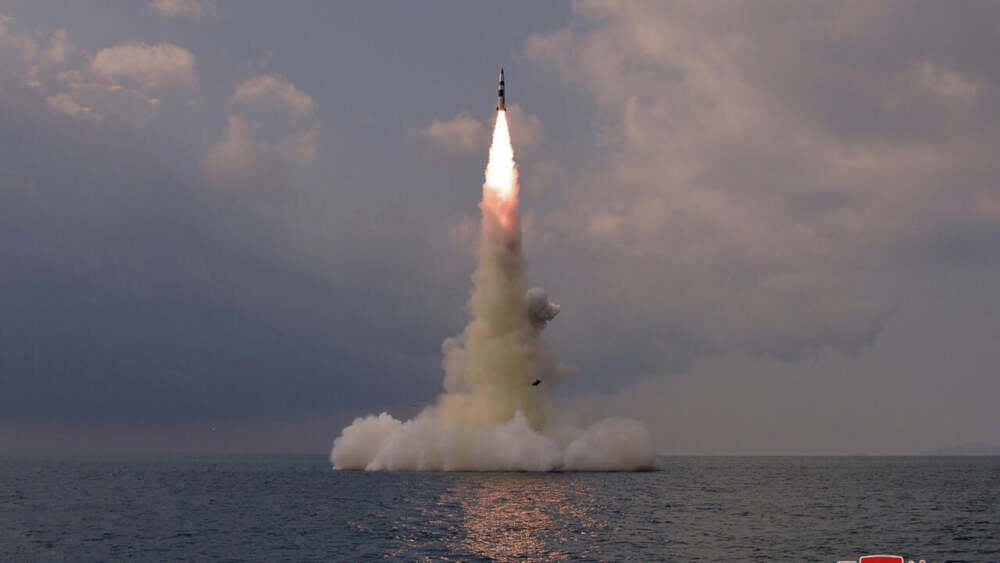
In a move that has reignited tensions across the Korean Peninsula, North Korea launched a short-range ballistic missile into its eastern waters on Friday morning. The test, confirmed by South Korea’s Joint Chiefs of Staff, marks Pyongyang’s latest act of defiance amid ongoing military exercises and diplomatic friction in the region.
Details of the Launch
According to early reports, the missile was fired from an inland area near Taekwan, in the western part of North Korea. It traveled roughly 700 kilometers before splashing down in the sea off the country’s eastern coast. Both South Korea and Japan tracked the missile’s flight path, confirming that it did not enter Japan’s exclusive economic zone. No damage to ships or aircraft was reported.
Military analysts say the launch appeared to be part of a series of tests intended to refine North Korea’s short-range and tactical missile capabilities. The launch came just days after South Korea and the United States concluded joint air exercises, which Pyongyang has repeatedly condemned as “provocations.”
Growing Frequency of Missile Tests
This latest launch continues a pattern of frequent weapons tests by North Korea throughout 2025. The regime of Kim Jong Un has steadily accelerated its missile program, conducting a variety of tests ranging from hypersonic weapons to submarine-launched ballistic missiles.
Experts believe these launches serve multiple purposes: to test the technical performance of new systems, to demonstrate strength to domestic audiences, and to pressure the international community into concessions. Each launch also functions as a political signal — a reminder that North Korea will continue to pursue its weapons agenda despite international condemnation or sanctions.
Regional and Global Responses
South Korea’s military quickly condemned the test, calling it a “serious provocation that threatens peace and stability on the Korean Peninsula.” Seoul has increased its alert level and is maintaining close coordination with the United States and Japan.
Japan’s Defense Ministry also denounced the launch, saying it was a “clear violation of United Nations Security Council resolutions” that prohibit North Korea from developing or testing ballistic missile technology. Japanese authorities confirmed that the missile landed outside of its territorial waters but emphasized that the threat level remains high.
The United States reaffirmed its commitment to defending both South Korea and Japan. The U.S. Indo-Pacific Command issued a statement saying that the launch “does not pose an immediate threat to U.S. personnel or territory,” but that it highlights the “destabilizing impact” of North Korea’s weapons program.
Analysts Weigh In
Regional security analysts view the timing of the launch as deliberate. It coincides with the strengthening of defense ties among Seoul, Tokyo, and Washington — including expanded intelligence sharing and joint military drills designed to deter North Korean aggression.
Dr. Lee Hyun-woo, a defense expert at Seoul’s Institute for Security Studies, explained, “These missile launches are not random. They are calibrated responses to international pressure. North Korea wants to remind the world that it cannot be ignored and that it has the power to disrupt stability whenever it chooses.”
Others point out that Kim Jong Un’s regime is likely testing the resolve of the new security cooperation framework between South Korea and Japan. After years of diplomatic tension between the two U.S. allies, the two nations have recently moved toward greater collaboration on missile defense and intelligence sharing — a trend Pyongyang views with hostility.
Diplomatic Stalemate
Despite years of sanctions and international isolation, North Korea shows no sign of scaling back its weapons development. The country has made significant progress in miniaturizing nuclear warheads and improving missile range and precision. Negotiations between Washington and Pyongyang have remained frozen since 2019, with both sides unwilling to compromise on key issues.
The North’s leadership maintains that its weapons are a necessary deterrent against what it calls “hostile policies” from the United States and its allies. Meanwhile, Washington insists that any meaningful dialogue must begin with Pyongyang’s commitment to denuclearization — a condition the North rejects outright.
The Broader Security Context
The launch comes at a time when the Indo-Pacific region is already grappling with multiple security flashpoints. China’s military maneuvers around Taiwan, ongoing tensions in the South China Sea, and Russia’s closer alignment with Pyongyang have created an increasingly complex security environment.
Some experts warn that North Korea could seek to exploit this global distraction to accelerate its weapons programs without drawing as much international attention. Others fear that the lack of diplomatic engagement could lead to miscalculations or unintentional escalation.
South Korea’s Response Strategy
South Korea has been strengthening its defense posture in response to repeated provocations. President Yoon Suk Yeol has emphasized a policy of “peace through strength,” focusing on developing indigenous missile defense systems and deepening military cooperation with the United States.
In addition, Seoul has deployed reconnaissance drones, improved early warning systems, and accelerated the construction of shelters and response centers in border areas. The government has also vowed to respond “decisively and immediately” to any direct threat to its territory or citizens.
What Lies Ahead
With North Korea’s weapons program advancing rapidly and diplomacy at a standstill, the risk of further provocations remains high. Analysts expect more missile tests in the coming months as Pyongyang continues to refine its systems and reinforce its leverage ahead of any future negotiations.
For now, the international community faces a difficult challenge: how to deter North Korea’s aggression without triggering a larger conflict, and how to reengage Pyongyang in dialogue while maintaining pressure to curb its weapons ambitions.
Final Thoughts
The latest missile launch is yet another reminder of the fragile peace that defines the Korean Peninsula. Each test adds to the growing uncertainty, pushing the region further from dialogue and closer to confrontation. As the world watches, one truth remains clear — North Korea’s pursuit of military dominance continues to reshape the balance of power in East Asia.

















Leave a Reply