


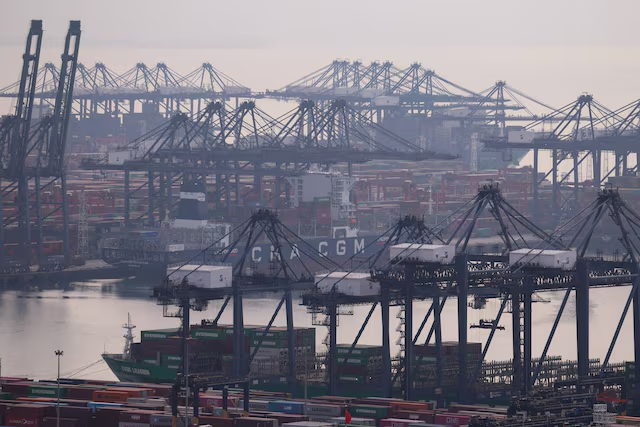
In an escalating standoff, China has tightened its control over rare earth exports—especially those tied to defense and high-tech applications—in a move that has significantly raised the stakes for any prospective U.S.–China trade deal. Analysts are now warning that Beijing could demand sweeping concessions, including easing U.S. restrictions on semiconductor exports, in exchange for delivering critical mineral access.
Beijing’s Export Clampdown and Strategic Messaging
China’s recent export controls go beyond raw materials, targeting the entire chain: mining, processing, magnet manufacturing, and even portions of design and technology transfers. These measures require foreign firms to secure Chinese approval even when only trace amounts of Chinese-sourced rare earths are used. The Chinese government frames its move in the language of safeguarding “world peace and regional stability,” signaling that the restrictions are not merely economic but deeply strategic.
By controlling a chokehold on rare earths—which power AI chips, advanced sensors, defense systems, and clean energy technologies—China now holds leverage at multiple junctures in global value chains.
Rare Earths for Chips: The Implicit Trade Proposal
With China wielding this control, speculation is growing that the country may insist on broader concessions as part of any agreement with the United States. One central possibility: dismantling or loosening U.S. export controls on semiconductors and related equipment in exchange for robust and stable access to rare earths.
Some market watchers see the contours of this trade already emerging. They argue that China will be reluctant to cede rare earth access without reciprocity in technology. The negotiation would not simply be about raw minerals, but rather about who controls the future of semiconductors, AI, aerospace, and defense.
U.S. Responses: Building Supply Chains Under Pressure
In recent months, U.S.-based rare earth companies have gained renewed attention and investment. Firms like MP Materials and USA Rare Earth have expanded operations and attracted backing from both private investors and government contracts. However, scaling these capabilities to meet the demand for high-purity processing and magnet production will take time, specialized infrastructure, and secure access to capital.
Domestically, Washington is racing to reduce Chinese dependencies. Strategic investments, procurement guarantees, and incentives for domestic magnet and rare earth projects are being deployed, but the supply chain remains fragile and vulnerable in the near term.
Market Reaction: Stocks Surge, Risks Heighten
The response in financial markets has been striking. Stocks of rare earth producers have leapt amid optimism over potential long-term tailwinds, though with sharp volatility. The rally reflects both the promise of new revenue streams and the fragility underlying global supply dependencies.
Yet the risk is high. Should negotiations falter or China use these export controls as a geopolitical weapon, entire sectors—defense, clean energy, consumer electronics—could face serious disruptions.
Broader Geopolitical Implications
This rare-earth tussle is more than a trade dispute. It is a battlefield in the emerging tech-power competition between the U.S. and China. Whoever controls the inputs—minerals, processing, magnets—could wield outsized influence over the middle layers of advanced systems, from AI chips to weapon guidance systems.
Countries allied with either superpower will feel the pressure. Nations seeking to diversify supply chains or reduce exposure to China are motivated to accelerate their own rare earth development programs, but many lack the capital, technology, or processing know-how to catch up quickly.
Conclusion: A New Flashpoint in the U.S.–China Rivalry
The rare earth sector has quietly become one of the most consequential fronts in the U.S.–China strategic competition. Beijing’s tightened export controls, together with its control over magnet and processing technology, give it a powerful bargaining chip. But this move is not without risk—if mishandled, it could backfire by galvanizing supply chain diversification and signaling systemic fragility in China-dependent industries.
Negotiations now extend into the realm of chips, national security, and industrial autonomy. The outcome of the rare earth dispute could reshape alliances, competitiveness, and strategic vulnerability for years to come.
















Leave a Reply