


In the silent darkness beyond Saturn’s rings, the icy moon Enceladus continues to captivate scientists with one of the most tantalizing mysteries in modern astronomy — the possibility that life might exist beneath its frozen crust. Recent research based on high-resolution data from NASA’s Cassini spacecraft has unveiled a new layer of chemical complexity within Enceladus’s ocean plumes, strengthening the argument that this distant world harbors the essential ingredients for life.
The findings reveal a vibrant chemical environment that mirrors — at least in part — conditions on Earth’s ocean floors, where life thrives in the absence of sunlight.
A Moon Unlike Any Other
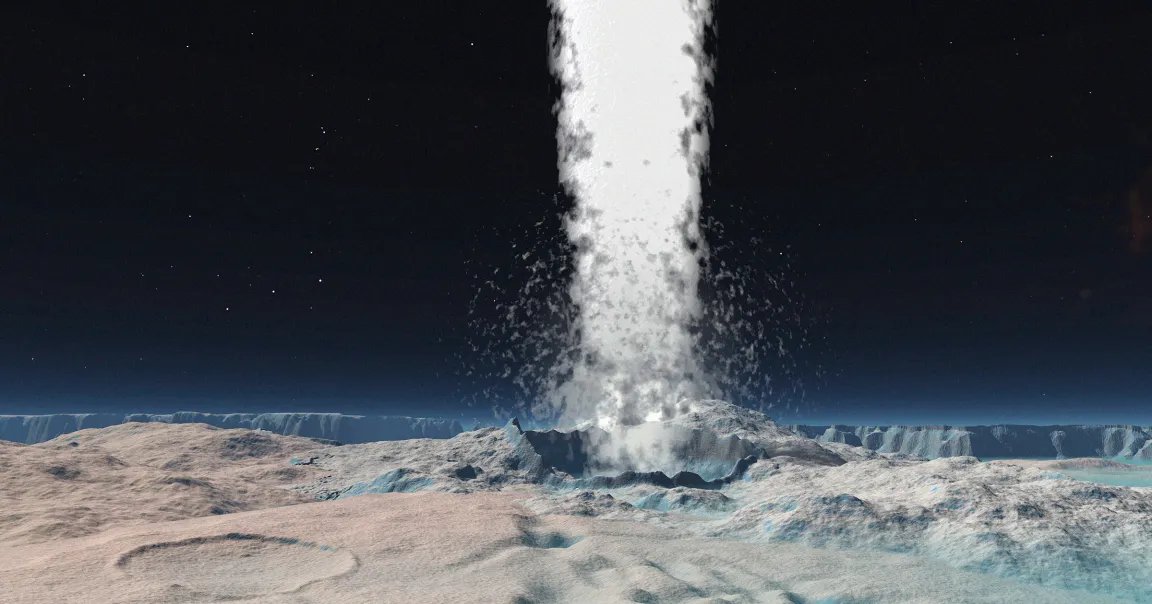
Discovered in 1789 by William Herschel, Enceladus remained largely unremarkable for centuries — just another small, icy satellite orbiting a gas giant. That perception changed forever in 2005, when the Cassini spacecraft captured images of towering geysers erupting from the moon’s south pole.
Those plumes of vapor and ice particles, venting from cracks known as “tiger stripes,” were a revelation. They proved that beneath the surface lies a liquid ocean, kept warm by gravitational forces and internal heating. The discovery transformed Enceladus into one of the most promising locations in the solar system for finding life beyond Earth.
Now, nearly two decades after Cassini’s discovery, scientists are uncovering new details hidden in its data — and what they’re finding is reshaping our understanding of how chemistry works on ocean worlds.
New Findings: A Chemical Symphony Beneath the Ice
The latest study focuses on a subset of ice grains ejected by Enceladus that were collected by Cassini’s Cosmic Dust Analyzer. These particular grains were “fresh,” having been expelled from the moon’s surface only moments before being intercepted by the spacecraft.
Because they spent less time exposed to cosmic radiation and solar particles, these ice grains preserved their original chemical makeup, offering an unprecedented glimpse into Enceladus’s subsurface environment.
Upon reexamining these samples, researchers detected a far greater diversity of organic molecules than previously known. The chemical signatures included ethers, esters, alkenes, aldehydes, and nitrogen-bearing compounds — complex organic substances that on Earth are linked to biological and prebiotic processes.
These findings suggest that Enceladus’s ocean is not just a static pool of water but a chemically dynamic environment, capable of sustaining intricate organic reactions over long timescales.
The Building Blocks of Life — Found Far From Earth
Organic molecules are the foundation of all known life. They form amino acids, sugars, and fatty acids — the essential ingredients for cell membranes and metabolic reactions. The presence of these compounds on Enceladus raises profound questions about how life might arise in alien environments.
What makes the discovery so compelling is not just the presence of organics but their diversity and abundance. The newly identified molecules are significantly more complex than the simple hydrocarbons detected earlier in Cassini’s mission. This level of molecular complexity implies that Enceladus’s ocean supports active chemical networks — the kind that could, under the right conditions, evolve into biochemistry.
If these reactions occur near Enceladus’s rocky core, where heat and mineral-rich water interact, they could mirror the hydrothermal systems that support microbial life on Earth’s ocean floors.
Hydrothermal Energy: The Engine of Enceladus’s Ocean
At the heart of Enceladus lies a rocky core that interacts directly with its global ocean. Scientists believe that tidal flexing — caused by Saturn’s immense gravitational pull — generates frictional heat inside the moon. This energy keeps the ocean from freezing and drives hydrothermal vents, where hot water and minerals mix to create an environment rich in chemical energy.
On Earth, such hydrothermal systems teem with life. Entire ecosystems thrive without sunlight, relying on chemosynthesis — the conversion of inorganic chemicals into organic energy sources.
Enceladus’s newly detected molecules could result from similar chemical processes. The discovery of molecular hydrogen (H₂) in earlier Cassini data already hinted that hydrothermal activity was occurring. Hydrogen is a potential energy source for microbes, just as it is for many deep-sea bacteria on Earth.
Now, the discovery of complex organics adds the missing piece: the raw materials for biological chemistry.
A Self-Sustaining Chemical Cycle
The emerging picture is of a moon with active, cyclical chemistry. Water circulating through the rocky core extracts minerals and energy. These materials rise into the ocean, where they interact with carbon compounds, forming ever more complex molecules.
As pressure builds, the mixture is vented into space through cracks in the ice shell, allowing spacecraft to collect samples directly from the plumes. This continuous exchange between core, ocean, and surface could have persisted for billions of years — a timeframe long enough for life, if it ever began, to take root.
The fact that such complexity exists without sunlight challenges long-held assumptions about where and how life can exist. It suggests that energy from rock-water reactions might be just as important as starlight in supporting living systems across the cosmos.
The Question of Life: Evidence vs. Possibility
Despite these tantalizing discoveries, scientists remain cautious. None of the detected molecules are direct indicators of biology. They could have formed through abiotic chemistry — natural reactions between water, minerals, and heat, without the involvement of life.
Still, the line between “prebiotic” and “biotic” chemistry is often thin. Many researchers believe Enceladus may represent a natural laboratory, where the processes that once sparked life on Earth are unfolding anew.
The moon’s environment fulfills all three classical criteria for habitability:
- Liquid water, protected beneath the ice;
- Energy sources, likely from hydrothermal reactions;
- Organic molecules, now proven to be diverse and abundant.
This combination makes Enceladus one of the most compelling targets in the search for extraterrestrial life — perhaps even more so than Mars.
Future Exploration: The Next Great Leap
The Cassini mission ended in 2017, deliberately plunging into Saturn’s atmosphere to avoid contaminating Enceladus. But the data it left behind continues to transform science.
Now, with these new revelations, interest in returning to the Saturn system is rising again. Several mission concepts are being proposed:
- A dedicated Enceladus orbiter capable of repeatedly flying through the plumes and analyzing fresh samples with next-generation instruments.
- A cryobot or lander that could penetrate the icy crust and explore the surface directly.
- Sample-return missions, designed to bring frozen plume particles back to Earth for detailed analysis.
Because Enceladus’s plumes naturally eject material from its ocean into space, future missions could explore its chemistry without drilling or contamination risks, making it a uniquely accessible target for astrobiology.
Broader Implications for Planetary Science
The discovery on Enceladus carries implications far beyond Saturn. It suggests that icy ocean worlds throughout the solar system — such as Jupiter’s moon Europa, Neptune’s moon Triton, and even distant dwarf planets like Pluto — may also host chemically active oceans.
It broadens the definition of the “habitable zone.” Life may not require a planet to be close to its star. Instead, warmth generated by gravitational tides and internal heat may sustain biological processes deep underground or under thick ice.
This means that the universe could be teeming with hidden oceans, each potentially nurturing microbial ecosystems in total darkness.
A New Chapter in the Search for Life
Enceladus has once again proven itself to be far more than an icy satellite. It is an active, evolving world where complex chemical reactions continue to reshape the boundary between geology and biology.
If life exists there — even microbial — it would revolutionize our understanding of biology, evolution, and the universality of life itself. But even if Enceladus is lifeless, it still holds the key to understanding how life begins.
Every molecule found, every plume analyzed, brings us one step closer to answering a question as old as humanity: Are we alone in the universe?
And thanks to the evidence building from this small moon, that answer may one day come from beneath an icy shell, orbiting a ringed planet nearly a billion miles from home.













Leave a Reply