

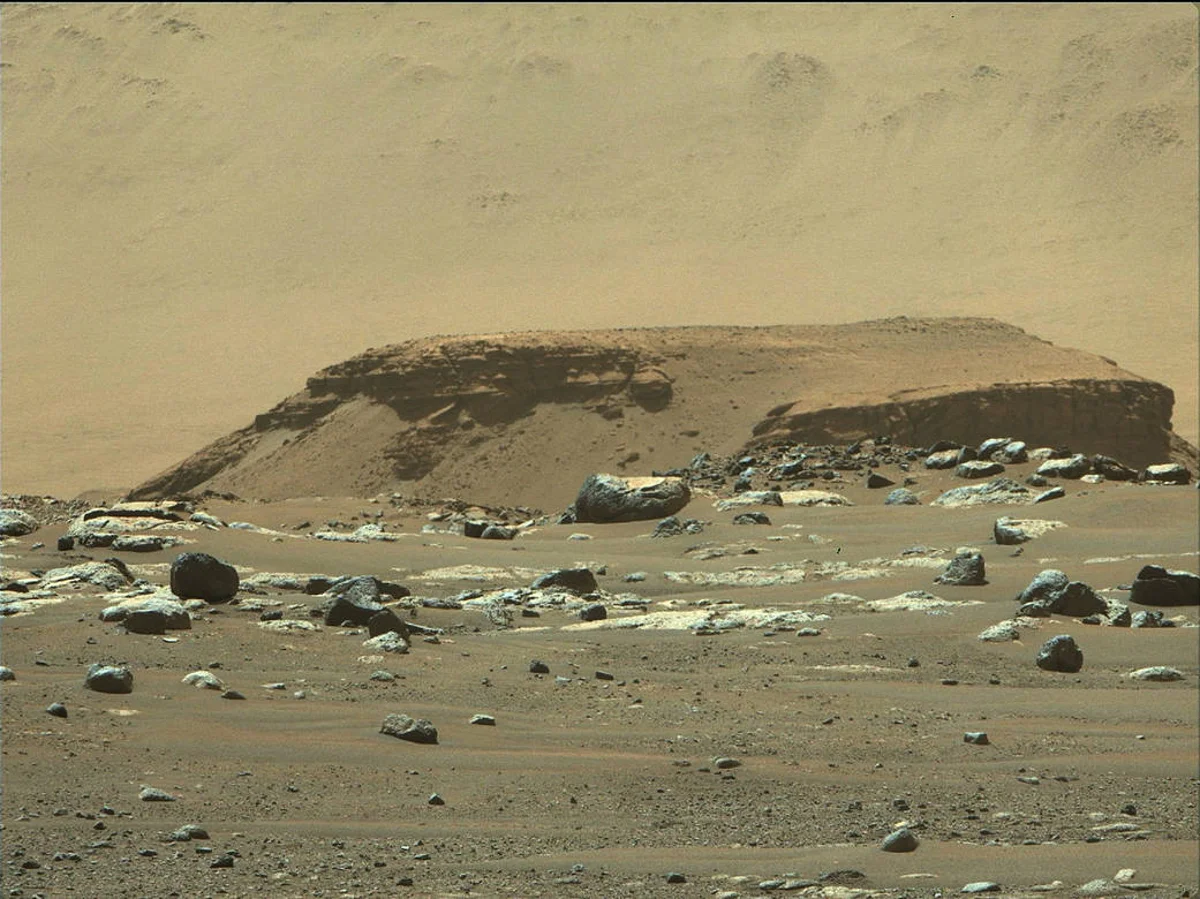
The red planet has once again captured global attention. NASA’s Perseverance rover, exploring Jezero Crater since 2021, has uncovered unusual rock formations that some experts believe could be the strongest signs yet of ancient Martian life. While the findings are still preliminary, they have ignited excitement across the scientific community, with many calling this moment a possible turning point in the search for extraterrestrial biology.
A Lake That Held Secrets for Billions of Years
Jezero Crater, where Perseverance has been working, was once home to a large lake nearly 3.5 billion years ago. This period is thought to have been one of Mars’ most Earth-like eras, when water flowed across its surface, creating rivers, lakes, and perhaps even shallow seas.
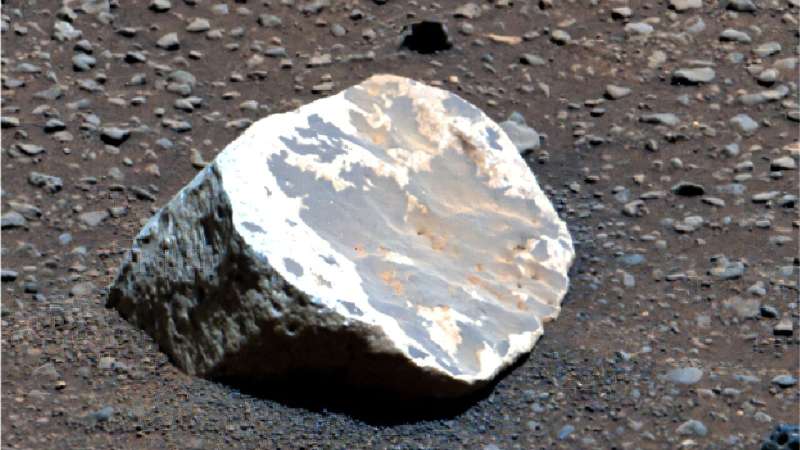
It is in this fossilized lakebed that the rover drilled into a rock formation showing peculiar, spot-like features. Scientists immediately recognized the importance of the find. On Earth, patterns like these often result from microbial activity that alters minerals and chemistry as organisms grow and leave behind traces in the sediment.
The “Leopard Spots” of Jezero Crater
The discovery revolves around unusual circular textures dubbed “leopard spots.” These pale circular patches, outlined by darker rims, are embedded in Martian rock samples collected by Perseverance.
To the untrained eye, they may appear decorative. But to astrobiologists, they are tantalizing. Similar textures in Earth rocks have been linked to the fossilized remains of microbial colonies that thrived in wet environments.
Adding to the intrigue, Perseverance’s suite of instruments detected a cocktail of elements and minerals within the samples:
- Organic molecules that contain carbon, the fundamental building blocks of life.
- Sulfur, iron, and phosphorus, all of which play crucial roles in biological systems.
- Iron-bearing minerals like greigite, which on Earth can form in microbial mats.
- Hydrated minerals that suggest the rocks interacted with water over extended periods.
Why This Is Different from Past “Hints”
Mars has teased scientists before. Over the years, orbiters, landers, and rovers have all picked up signs of organic molecules, methane bursts, or mineral deposits that could point to life. But every time, alternative explanations rooted in geology have kept the evidence from being conclusive.
This discovery, however, stands out for one key reason: it brings together several biosignature candidates at once. Organic chemistry, water-altered minerals, and microbial-like textures all appear in the same place, within the same rocks.
Dr. Laurie Leshin, director of NASA’s Jet Propulsion Laboratory, summarized the mood best: “We cannot say we’ve found life, but we may be looking at the strongest case for it so far.”
The Scientific Caution
Despite the excitement, researchers emphasize caution. Mars is a world shaped by volcanic eruptions, chemical weathering, and dust storms. Non-living processes can produce organic molecules and complex mineral textures, sometimes mimicking biology.
For example, the “leopard spots” could theoretically form through purely chemical reactions as minerals crystallize under changing conditions. Without further evidence, scientists cannot yet distinguish between biological and abiotic explanations.
This is why the phrase “potential biosignature” is being used, rather than a declaration of life.
The Role of Mars Sample Return
To move forward, NASA plans to bring Martian rock cores back to Earth for advanced study. Perseverance has already sealed dozens of samples in protective tubes, including those with the “leopard spots.”
The proposed Mars Sample Return mission would retrieve them and deliver them to Earth laboratories by the mid-2030s. There, scientists could use advanced microscopes, isotopic analysis, and chemical testing far beyond the rover’s capabilities.
But the mission faces political and financial hurdles. With costs projected to rise above $10 billion, lawmakers have debated whether the program can move ahead without international partners. Delays could push the timeline back years.
Still, if successful, these samples could finally answer whether Mars once hosted microbial ecosystems.
Why It Matters Beyond Mars
The implications of even a modest confirmation are staggering. Finding evidence of life on another planet—even if only fossilized microbes—would show that life is not a rare cosmic accident but a natural outcome of planetary evolution.
If Mars, a small rocky world with a thin atmosphere and harsh conditions, once nurtured microbes, then countless exoplanets orbiting distant stars might also harbor biology. It would redefine humanity’s place in the universe.
On the other hand, if the signatures prove to be purely chemical, that too would be valuable. It would expand our understanding of how complex geochemical processes operate beyond Earth, teaching scientists how to distinguish between biological and abiotic signals in the search for life elsewhere.
Humanity’s Ongoing Quest
The Martian rocks of Jezero Crater are silent, but their patterns speak volumes. Whether they reveal traces of life or simply geology, they bring us closer to solving one of humanity’s greatest mysteries.
For now, scientists remain cautious but hopeful. Each drilled sample, each detected molecule, and each curious texture reminds us that Mars is not just a dusty world, but a planet with a story still being written.
And somewhere in that story, perhaps hidden within the “leopard spots,” may lie the first chapter of life beyond Earth.












Leave a Reply