


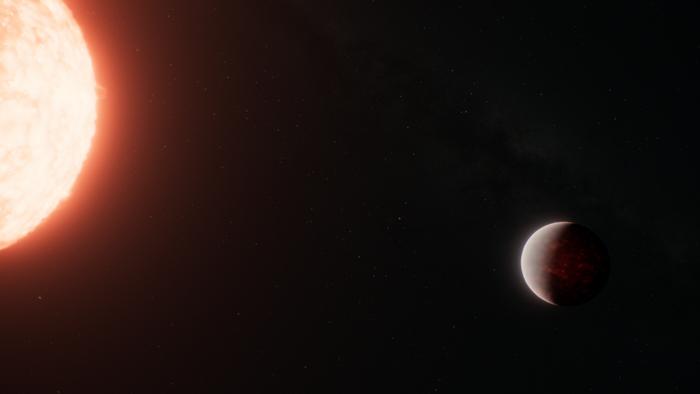
Astronomers have uncovered new evidence suggesting that a bizarre exoplanet, nicknamed the “wet lava ball,” may possess an atmosphere—an unexpected finding for a world previously thought to be a scorching, airless rock. The discovery offers fresh insights into the diversity of planetary systems and challenges existing models of exoplanetary atmospheres.
The exoplanet, officially designated TOI-1431b, orbits extremely close to its host star, completing a revolution in just under two days. Its proximity to the star exposes the planet to intense stellar radiation, heating its surface to temperatures above 2,500°C (4,500°F). This extreme environment led scientists to initially assume that any atmosphere would have long since evaporated.
However, new observations using high-precision spectroscopy reveal subtle signs of gas absorption, consistent with a tenuous, exotic atmosphere. Researchers detected faint spectral lines that may indicate the presence of vaporized metals, such as magnesium and iron, as well as potential traces of molecular compounds that could survive under extreme conditions.
“This planet is unlike anything we’ve studied before,” said Dr. Lina Torres, an astrophysicist involved in the study. “We’re seeing hints that even planets with extreme surface temperatures may maintain a thin, exotic atmosphere, which challenges our understanding of atmospheric retention in ultra-hot worlds.”
The discovery has significant implications for exoplanet science. Traditionally, planets orbiting so close to their stars were assumed to be barren, molten surfaces with little to no atmosphere. The possibility that TOI-1431b retains an atmospheric layer suggests that some extreme exoplanets may be more chemically and dynamically complex than previously thought.
Astronomers caution that the findings are preliminary. Future observations, including those using the James Webb Space Telescope (JWST), aim to confirm the composition and structure of the atmosphere. Understanding how such a planet retains gaseous material despite its extreme conditions could reshape models of planetary formation, migration, and atmospheric evolution.
The “wet lava ball” nickname comes from theoretical models suggesting that its surface may partially melt and re-solidify, creating a dynamic environment of molten rock flows and vapor plumes. The potential atmosphere could interact with these processes, producing exotic weather patterns unlike anything in our solar system.
“This is a reminder that the universe is more varied and surprising than our models predict,” Dr. Torres added. “Even in the harshest environments, planets can defy expectations, offering unique laboratories for studying physics, chemistry, and planetary evolution.”













Leave a Reply